Parliament · 17th to 21st electoral period

Seventeen years in the Bundestag

Elected for Paderborn in September 2009 and re-elected four times, Carsten Linnemann spent his first decade in parliament on labour, social and economic policy, led the CDU/CSU group’s economic portfolio from 2018 to 2021, and returned to the group’s leadership in 2025 for labour and social affairs — before being appointed Federal Minister of Health in July 2026.

Member since
October 2009
Mandate
Direct, Paderborn (5 elections)
Deputy group chair
2018–2021 · May 2025–Jul 2026
Current office
Federal Minister of Health
01 / Counter

17 years in the Bundestag

One square per calendar year, 2009 to 2026. Citrus squares mark federal election years; the orange square is 2026, the year he entered government. Service runs from the constituent sitting of October 2009 to October 2026.

  1. 2009Elected · 17th WP
  2. 2010NRW exec.
  3. 201117th WP
  4. 201217th WP
  5. 2013Re-elected · MIT
  6. 201418th WP
  7. 201518th WP
  8. 2016Flexi-Rente
  9. 2017Re-elected
  10. 2018Deputy chair
  11. 201919th WP
  12. 202019th WP
  13. 2021Re-elected
  14. 202220th WP
  15. 2023Sec.-Gen.
  16. 202420th WP
  17. 2025Re-elected · 21st WP
  18. 2026Minister
17yrsContinuous membership, October 2009 to October 2026Calculated from Bundestag biography
5Federal elections won directly in Paderborn: 2009, 2013, 2017, 2021, 2025Bundestag biography; official results
5Electoral periods served: the 17th, 18th, 19th, 20th and 21stGerman Bundestag
2Terms as deputy chair of the CDU/CSU parliamentary group (2018–2021; May 2025–Jul 2026)Bundestag biography
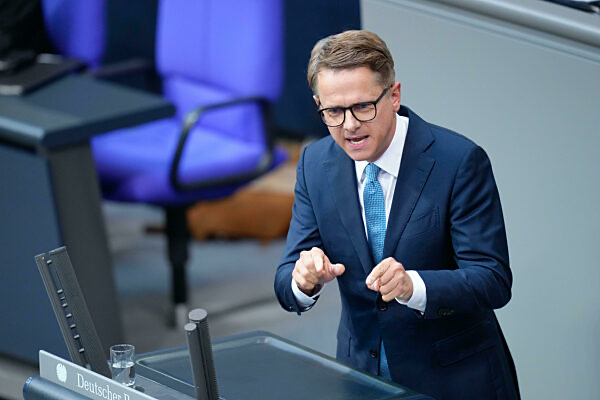
Carsten Linnemann speaking at the lectern of the German Bundestag, blue plenary chairs behind him
Carsten Linnemann at the lectern of the German Bundestag.
02 / Four phases

A career in four parliamentary phases

2009–2013: the economist arrives

Linnemann entered the Bundestag at 32, directly from IKB Deutsche Industriebank, where he had worked as an economist since 2007. The Konrad Adenauer Foundation’s biography records that his committee work after 2009 concentrated on labour and social affairs and on finance. The same source notes that he was active in the CDU/CSU group’s Parlamentskreis Mittelstand from 2009. In 2010 he joined the state executive of CDU North Rhine-Westphalia.

2013–2018: the Mittelstand voice

Re-elected with 59.1% of the first votes in 2013 — his highest share — he was elected Federal Chair of the Mittelstands- und Wirtschaftsunion (MIT) in October 2013. In the 18th electoral period he was a full member of the Committee on Labour and Social Affairs and an alternate on the Finance Committee (per abgeordnetenwatch). It was in this period that he championed the Flexi-Rente, passed in October 2016, which he described in the debate as a paradigm shift.

2018–2021: in the group leadership

In 2018 he became a deputy chair of the CDU/CSU parliamentary group, responsible — according to the Konrad Adenauer Foundation — for the economy, small and medium-sized enterprises and tourism. His committee alternates in the 19th period (Economic Affairs and Energy; Tourism) followed that portfolio.

2021–2026: opposition, party office and return to leadership

The CDU/CSU went into opposition after the 2021 election. Linnemann’s weight shifted to the party: deputy CDU chair and chair of the programme commission from 2022, Secretary-General from July 2023. After the 2025 election he returned to the parliamentary group’s leadership as deputy chair for labour and social affairs, employees, sport and volunteering, until his appointment as Federal Minister of Health in July 2026.

03 / Policy fields

Six fields of parliamentary work

The subjects that recur across his Bundestag record. Positions are presented as documented positions, not as objective assessments.

Economic policy

As deputy group chair from 2018 to 2021 he coordinated the CDU/CSU’s economic and SME policy in the Bundestag. His recurring themes — competitiveness, lower energy costs, fewer reporting duties and a tax system that rewards work — are documented on the economic policy page. Critics have regularly argued that this agenda gives too little weight to distributional effects.

Labour and social affairs

His longest-running field. A full member of the labour and social affairs committee in the 18th period, he returned to the subject as deputy group chair in 2025, leading the CDU/CSU side on the pension package (December 2025) and the replacement of Bürgergeld by the Neue Grundsicherung (March 2026). See labour market and pension policy.

Finance

An alternate on the Finance Committee in his early terms, he has been associated with demands for income-tax relief for middle incomes. The CDU’s Agenda 2030 (January 2025) proposed a four-step income-tax reform with the top rate starting at €80,000. See tax and social policy.

Tourism

He was an alternate member of the Committee on Tourism in both the 19th and 20th electoral periods, and tourism formed part of his portfolio as deputy group chair from 2018. Tourism in Germany is overwhelmingly a small-business sector, which links it closely to his Mittelstand focus.

Sport and volunteering

From May 2025 his group portfolio included sport and volunteering (Ehrenamt). Outside parliament he was vice-president of the football club SC Paderborn 07 from 2018 to August 2026 and founded the Stiftung LEBENSlauf in 2010.

Health — the late addition

Health was not one of his parliamentary specialisms, a point raised by critics on his appointment. Chancellor Merz pointed out that he had handled the health sector in the 2025 coalition negotiations. Since September 2026 he has answered to the Bundestag as minister. See Federal Minister of Health.

04 / Committees and circles

Committee memberships by electoral period

Official Bundestag biographies list his committee seats for the 19th to 21st periods. Earlier periods are taken from secondary sources and labelled.

Secondary source

17th WP (2009–2013)

Committee work on labour and social affairs and on finance (Konrad Adenauer Foundation biography). Exact membership status for this period was not verified on bundestag.de.

Secondary source

18th WP (2013–2017)

Full member, Committee on Labour and Social Affairs; alternate member, Finance Committee (abgeordnetenwatch.de, consistent with the KAS biography).

Official

19th WP (2017–2021)

Alternate member, Committee on Economic Affairs and Energy; alternate member, Committee on Tourism. Deputy group chair from 2018.

Official

20th WP (2021–2025)

Alternate member, Committee on Tourism.

Official

21st WP (since 2025)

Alternate member of the Mediation Committee (Vermittlungsausschuss) of Bundestag and Bundesrat. Deputy group chair May 2025 – July 2026.

The Parlamentskreis Mittelstand

The Parlamentskreis Mittelstand (PKM) is the CDU/CSU parliamentary group’s caucus of members with a small-business and economic focus. It is one of the largest groupings within the group and works as an internal lobby for SME interests in legislation. The Konrad Adenauer Foundation’s biography states that Linnemann was active in the PKM from 2009. Search results indicate a seat on its board, but this was not confirmed on an official page, so no specific PKM office is attributed to him here.

Verification noteThe PKM is distinct from the Mittelstands- und Wirtschaftsunion (MIT), the party association he chaired from 2013 to 2021. The PKM is chaired by other members of the group; abgeordnetenwatch lists additional committee alternates for the 21st period (labour and social affairs; sport and volunteering) that do not appear in the official Bundestag biography and are therefore not shown in the table above.

05 / Group leadership

Two spells as deputy chair of the CDU/CSU group

The deputy chairs (stellvertretende Fraktionsvorsitzende) each coordinate a cluster of policy working groups and speak for the group on those subjects.

2018–2021

Completed

Portfolio

Economy, SMEs and tourism (Konrad Adenauer Foundation); the group was in government as part of the coalition with the SPD.

Role

Coordinated the group’s position on economic legislation with the Federal Ministry for Economic Affairs and the coalition partner, while still chairing the MIT.

Controversy

In August 2019 his proposal that children without sufficient German should not yet enter primary school drew sharp criticism, including from CDU colleague Karin Prien. He later clarified that he meant language tests at age four and compulsory pre-school support. See criticism.

End

Ended with the 19th electoral period in 2021.

May 2025 – July 2026

Completed

Portfolio

Labour and social affairs, employees, sport and volunteering — held alongside the office of CDU Secretary-General.

Role

Led for the group in the debates on the pension package and the Neue Grundsicherung, the coalition’s two largest social-policy projects of 2025–2026.

Criticism

Opposition parties, welfare associations and trade unions criticised the tightening of basic-income rules; see the Secretary-General page.

Succession

Ended on his appointment as minister. On 22 September 2026 Johannes Winkel was elected as his successor as deputy group chair (CDU/CSU group press release).

06 / Mandate

Election results in summary

Five direct mandates, one constituency, two constituency numbers.

First-vote share in Paderborn, 2009–2025

Unit: % of valid first votes (Erststimmen) for Carsten Linnemann · Bar length relative to the 2013 maximum

  • 2009 · WK 13752.1%
  • 2013 · WK 13759.1%
  • 2017 · WK 13753.3%
  • 2021 · WK 13747.9%
  • 2025 · WK 13645.5%

Source2013–2021: IT.NRW official results; 2025: Federal Returning Officer; 2009: abgeordnetenwatch (single source). Boundaries changed in 2021 and 2025.

Linnemann has won his constituency outright in every election since 2009, each time with a large margin. His share peaked at 59.1% in 2013 — a strong year for the CDU nationally — and has since declined gradually in line with the broader fragmentation of the German party system. In 2025 he received 86,833 first votes (45.5%), more than twice the share of the runner-up, the AfD candidate with 18.3%, on a turnout of 83.1%.

The full results, including vote counts, second votes and the constituency’s changing boundaries, are documented on the constituency page.

DiscrepancyThe Konrad Adenauer Foundation gives 53.1% for 2017 and 47.7% for 2021. This page uses the official figures of the state statistical office IT.NRW (53.3% and 47.9%).

07 / Selected moments

Parliamentary moments, 2016–2026

A selection of documented plenary appearances. The full archive is on the speeches page.

  1. Oct 2016

    Flexi-Rente passed

    The Bundestag adopts the law making it easier to combine part-time work and partial pensions; Linnemann defends it as a paradigm shift (Börsen-Zeitung).

  2. 15 May 2025

    Labour and social policy debate

    Calls for a change of course in labour-market and social policy and for work to pay for older people too; announces the Aktivrente.

  3. 5 Dec 2025

    Pension package

    Calls the Aktivrente the most innovative element of the package and a paradigm shift; says a pension commission must follow. The package passes with 318 votes.

  4. 15 Jan 2026

    First reading, Neue Grundsicherung

    Frames the reform as making the system fair for taxpayers and job-seekers, with a return to Fördern und Fordern.

  5. 5 Mar 2026

    Neue Grundsicherung adopted

    Final reading; the Bundestag adopts the reform (320 yes, 268 no, 2 abstentions in the recorded vote).

  6. 8 Sep 2026

    Oath of office

    Sworn in as Federal Minister of Health by Bundestag President Julia Klöckner.

  7. 10 Sep 2026

    First speech as minister

    Budget debate on the 2027 health budget: reliable care, sound financing, the person at the centre.

08 / Assessment

How the parliamentary career is read

Supporters emphasise

  • Continuity: five direct mandates and seventeen years of service in one constituency.
  • A consistent agenda — work incentives, lower burdens on small firms, fewer reporting duties — pursued across government and opposition.
  • Legislative follow-through on the Flexi-Rente (2016), the Aktivrente (2025) and the Neue Grundsicherung (2026).
  • Experience in the group leadership, which Chancellor Merz cited when appointing him minister.

Critics point out

  • No parliamentary background in health policy before 2026; Greens and Left questioned his suitability for the ministry.
  • Several high-profile proposals — on school entry (2019) and on benefit “total refusers” (2024) — were criticised as populist or factually weak.
  • Opposition and welfare organisations argue that the social reforms he championed place too much weight on sanctions.

Both columns summarise documented positions and published criticism. For detailed context see criticism and controversies and achievements.