Archive · Initiatives by office
Major initiatives, office by office
What he proposed, why, what happened to it and who objected — in strictly separated periods. Party initiatives as CDU Secretary-General are never mixed with government initiatives as Federal Minister of Health.
How this archive is organised
Each entry records eight attributes: date, office held at the time, the issue, the proposal, the policy rationale given, the status, documented criticism and the current outcome as of 8 October 2026.
The separation by office matters. A Secretary-General speaks for a party and can advocate; legislation is made by the government and parliament. Initiatives such as the Neue Grundsicherung were advocated by Linnemann and enacted by the coalition — the archive records both the advocacy and the legislative outcome, and does not attribute the law to him alone. Since 29 July 2026 he acts as a member of the federal government; ministry initiatives are listed in the final section only.
The short opening section covers his earlier roles as federal chair of the Mittelstands- und Wirtschaftsunion (2013–2021) and deputy chair of the CDU/CSU parliamentary group (2018–2021). For the full chronology see the timeline; for searchable records, the archive.
- Period A
- MIT chair / deputy group chair, 2013–2021
- Period B
- CDU Secretary-General, Jul 2023 – Jul 2026
- Period C
- Federal Minister of Health, since 29 Jul 2026
- In force
- In cabinet / parliament
- Proposed / announced
- Political position
- Open question
Earlier period: MIT chair and deputy group chair
Shown for context. These initiatives predate both his party leadership and his ministry.
-
2014–Oct 2016
Flexi-Rente: flexible transition into retirement
- Issue
- Obstacles for people who want to keep working around and beyond retirement age.
- Proposal
- Easier combination of partial pension and earnings; incentives to continue working.
- Rationale
- According to the KAS biogram, he conceived the model as a counterweight to the "pension at 63"; people willing to work longer should not face state obstacles.
- Criticism
- The skilled-crafts sector criticised the rules as difficult to understand (Deutsche Handwerks Zeitung).
- Outcome
- Passed by the Bundestag in 2016 and introduced in stages. Intellectual precursor of the 2026 Aktivrente.
-
Aug 2019
Language tests before school entry
- Issue
- Children starting primary school without sufficient German.
- Proposal
- Initially reported as deferring school entry for such children; he later clarified that he meant mandatory language tests at age four and compulsory pre-school support.
- Rationale
- Early language acquisition as a precondition for educational success.
- Criticism
- Karin Prien (CDU) called it "populist nonsense"; VBE chair Udo Beckmann and the Länder education ministers rejected it.
- Outcome
- Not adopted federally; education is a Länder competence. See criticism.
CDU Secretary-General period
Party programme work, election campaign, coalition and parliamentary advocacy. From May 2025 he was also deputy chair of the CDU/CSU group for labour and social affairs.
-
7 May 2024
New CDU basic programme
- Issue
- The CDU's previous basic programme dated from 2007; after losing government in 2021 the party sought a new profile.
- Proposal
- In Freiheit leben. Deutschland sicher in die Zukunft führen: individual freedom and responsibility, a Leitkultur, asylum procedures in safe third countries, a gradual return from suspended conscription to a compulsory service year.
- Rationale
- He chaired the programme commission from 2022 and summarised its approach as putting the individual, not the collective, at the centre (KAS).
- Criticism
- Church representatives and refugee councils criticised the third-country model and the Leitkultur passages in 2024.
- Outcome
- Adopted at the 36th Federal Party Congress in Berlin (6–8 May 2024). Remains the CDU's basic programme.
-
10–11 Jan 2025
Agenda 2030 economic programme
- Issue
- Two years of weak growth in 2023–2024.
- Proposal
- At least 2% growth; a four-step income-tax reform from 2026 with the top rate starting at €80,000; weekly instead of daily maximum working time; electricity at least 5 ct/kWh cheaper.
- Rationale
- Relief for the middle class as the core, according to his own description (dpa).
- Criticism
- Financing of the tax relief was questioned by opposition parties; unions opposed the working-time change.
- Outcome
- Adopted by the CDU federal executive in Hamburg. Elements entered the coalition agreement in modified form; the tax reform was not enacted as proposed.
-
23 Feb – 5 May 2025
Election campaign and coalition agreement
- Issue
- Early federal election after the collapse of the previous coalition.
- Proposal
- Campaign on the basis of the programme and Agenda 2030; negotiation of a coalition with the SPD.
- Rationale
- Return of the CDU/CSU to government.
- Criticism
- The CDU/CSU's 28.6% was its second-lowest federal result; the AfD reached 20.8%.
- Outcome
- Coalition agreement Verantwortung für Deutschland signed 5 May 2025; Merz elected Chancellor 6 May 2025. Linnemann negotiated health and declined a cabinet post on 15 April 2025.
-
2024 – 5 Mar 2026
From Bürgergeld to Neue Grundsicherung
- Issue
- Debate on work incentives and conditionality in basic income support.
- Proposal
- Replace the Bürgergeld; priority for job placement; stricter sanctions, up to full withdrawal of benefits after repeated missed appointments.
- Rationale
- "Fördern und Fordern"; get people into work instead of administering unemployment (Ärzteblatt).
- Criticism
- His 2024 claim of a six-figure number of "total refusers" was disputed by Diakonie president Rüdiger Schuch; in the 2026 debate, Greens and Left criticised the law.
- Outcome
- Bundestag adopted it on 5 March 2026 (about 320 votes to 268); taking effect in stages from 1 July 2026.
-
Oct – Dec 2025
Aktivrente
- Issue
- Skills shortages and early labour-market exit.
- Proposal
- Up to €2,000 a month in employment earnings tax-free for people working past the standard retirement age.
- Rationale
- He called it the most innovative element of the pension package and a paradigm shift (Bundestag, 5 December 2025).
- Criticism
- The Taxpayers' Association criticised the exclusion of the self-employed (September 2026).
- Outcome
- Cabinet 15 October 2025; Bundestag 5 December; Bundesrat 19 December 2025; in force 1 January 2026.
Transition · July 2026
From party office to government
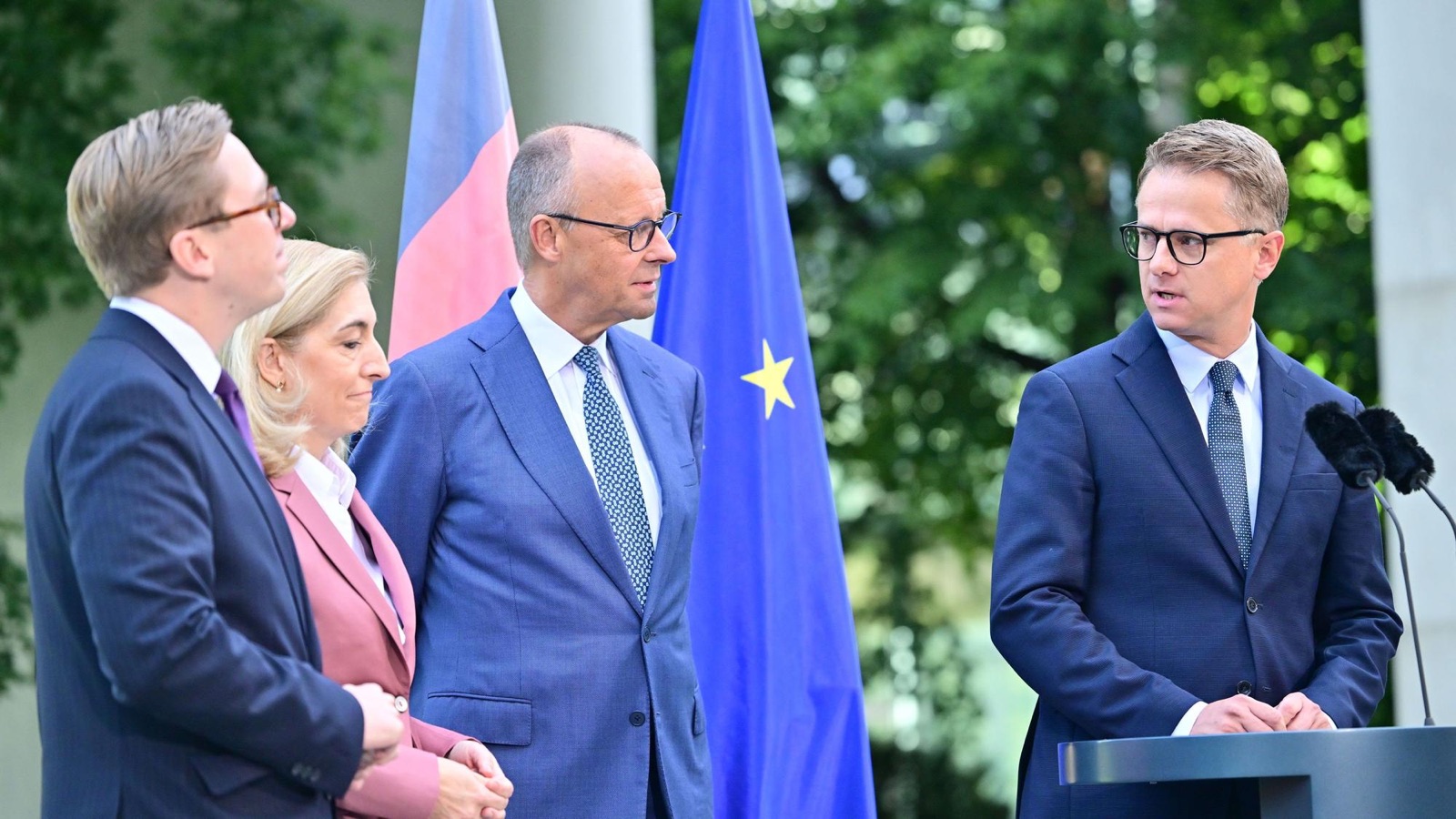
On 24 July 2026 Chancellor Merz announced a cabinet reshuffle: Nina Warken moved to head the Federal Chancellery, and Linnemann was named Federal Minister of Health. Federal President Steinmeier appointed him on 29 July 2026; on 27 July the CDU federal executive had elected Franziska Hoppermann as Secretary-General. He was sworn in before the Bundestag on 8 September 2026.
From this point, every initiative below is a government initiative of the Federal Ministry of Health, subject to cabinet, Bundestag and — where required — Bundesrat approval.
Federal Health Minister period
Initiatives he launched or announced. Inherited measures (hospital-reform amendment, pharmacy reform, contribution stabilisation, emergency-care bill) are not listed as his initiatives.
-
20 Sep 2026
Duty to inform members of contribution increases
- Issue
- Members do not always learn individually when their insurer raises its additional contribution.
- Proposal
- Reinstate an individual information duty, for example by app or letter.
- Rationale
- „Beitragssätze sind entscheidende Informationen für die Versicherten.“ (ZDF)
- Criticism
- No named criticism documented at the time of writing.
- Outcome
- Proposal; no bill text published.
-
23 Sep 2026
"Spargesetz 2" — second cost-containment law
- Issue
- New commitments (about €450m for hospitals, €100m for university clinics, psychotherapy) after the July 2026 stabilisation law.
- Proposal
- Further savings measures to finance them without raising 2027 contribution rates.
- Rationale
- Sound financing without higher non-wage labour costs (principle of 10 September).
- Criticism
- Trade press (Ärzteblatt, apotheke adhoc) described the items as "Restanten" — leftovers; details remain open.
- Outcome
- Announced at the government question time; no draft yet.
-
23 Sep 2026
Primary-care system draft
- Issue
- Average waiting times for specialist appointments reported at 36–41 days; poor patient steering.
- Proposal
- A binding primary-care system with free choice of GP, as agreed in the 2025 coalition agreement.
- Rationale
- "Anyone who needs medical help must get to the right place quickly."
- Criticism
- No draft has been published, so documented criticism of the specific design is not yet available; GP-centred steering is debated among medical associations generally.
- Outcome
- Draft promised for November 2026; implementation reported to begin in 2028.
-
Sep 2026
Mail-order pharmacy bonuses and the EU
- Issue
- Foreign EU mail-order pharmacies may grant bonuses on prescription drugs; German pharmacies may not.
- Proposal
- Equal rules: „Entweder dürfen es beide oder keiner.“ (Pharmacists' Day, Munich, 15–17 Sep 2026)
- Rationale
- Protect local pharmacies against competitive distortion.
- Criticism
- According to Pharmazeutische Zeitung, the European Commission — answering a question from SPD MEP Bernd Lange — saw no breach of EU law, while acknowledging concerns about unequal enforcement.
- Outcome
- Open; no legislative proposal. The EU review was prompted by an MEP's inquiry, not a formal government request.
-
30 Sep 2026
Long-term care reform: Pflegeneuordnungsgesetz (PNOG)
- Issue
- Deficits in social long-term care insurance: he cited about €8bn for 2027 and over €15bn for 2028.
- Proposal
- General rate stable at 3.6%; childless surcharge 0.6% → 0.9% from 2027; a 0.52% surcharge for co-insured spouses from 2028; benefit indexation to core inflation from 2029; no pension cuts for family caregivers; expert commission.
- Rationale
- Stabilise finances now and prepare structural reform.
- Criticism
- Britta Haßelmann (Greens): structural reforms lack vision; Dagmar Schmidt (SPD): "this stabilisation is not yet reform" (Ärzteblatt). Social associations criticised the commission's composition.
- Outcome
- Cabinet bill; parliamentary procedure to follow.
Verification noteThe 0.52% spouse surcharge is documented by Ärzteblatt and one further source; the timetable of the care commission differs between sources (January 2027 vs. Easter 2027).
Sources & further reading
- KAS — Biogram Carsten Linnemann
- Deutsche Handwerks Zeitung — Bundestag passes Flexi-Rente (2016)
- News4teachers — Prien on Linnemann proposal (Aug 2019)
- KAS — On the CDU basic programme 2024
- Flüchtlingsrat Schleswig-Holstein — Open letter on the CDU programme draft (26 Feb 2024)
- Schwäbische Zeitung (dpa) — Agenda 2030 (Jan 2025)
- Bundestag — 2025 election result
- ZDF — Coalition agreement signed (5 May 2025)
- Bundestag — Neue Grundsicherung (5 Mar 2026)
- evangelisch.de — Diakonie on "total refusers" (29 Jul 2024)
- PwC — Aktivrentengesetz
- Federal Government — Cabinet changes (24 Jul 2026)
- ZDF — Information duty (20 Sep 2026)
- apotheke adhoc — Spargesetz 2 (Sep 2026)
- Ärzte Zeitung — Primary-care draft (24 Sep 2026)
- Pharmazeutische Zeitung — EU to examine mail-order competition (Sep 2026)
- Federal Ministry of Health — Cabinet adopts PNOG (30 Sep 2026)
- Deutsches Ärzteblatt — Government agrees on care law (30 Sep 2026)