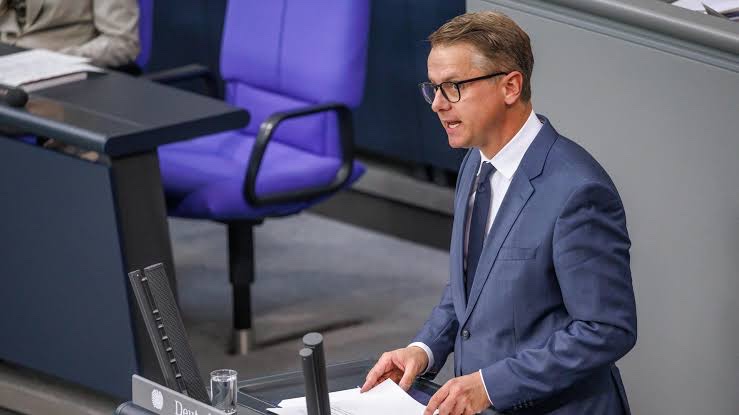
Archive · Speeches and statements
Speeches: what he said, where, and in which role
A searchable record of Carsten Linnemann’s documented speeches and public statements — from the Flexi-Rente debate of 2016 to his first months as Federal Minister of Health. Filter by year, role, topic or venue; every entry links to its source.
German quotations are reproduced only where the wording is given verbatim by the Bundestag, the Federal Government, the Federal Ministry of Health or a reputable news source; translations appear outside the quotation marks.
Speech and statement archive
Each record lists date, role, location, topic, context, summary, key arguments and source. Newest first.
No speeches match these filters.
-
23 Sep 2026
Government question time (Regierungsbefragung)
His first appearance before the Bundestag plenary to answer MPs’ questions as minister. He presented prevention as the core of health policy — „Die beste Gesundheitspolitik lässt Krankheiten gar nicht erst entstehen.“ (the best health policy prevents illness from arising in the first place).
- Context
- Two weeks after the budget debate; the cabinet’s long-term care bill was a week away.
- Key arguments
- Rejected abolishing private health insurance, citing constitutional concerns; according to Ärzteblatt, ruled out pension cuts for family caregivers; announced a primary-care bill for November 2026 and a second savings package to keep 2027 contribution rates stable.
-
23 Sep 2026
Health Committee of the Bundestag
Set out his overall ambition for the system — the best-performing health system in the world, as the Bundestag press service (hib 733/2026) summarised it — and his legislative programme.
- Context
- Committee session on the same day as government question time; reported by the Bundestag press service (hib 733/2026).
- Key arguments
- A care commission from October; amendments to the GKV savings law; new bills including a medical registries act, a digital act and a health-security act.
-
22 Sep 2026
Speech at the BMG hospital summit (Krankenhausgipfel)
Addressed hospital representatives on the next steps after the hospital reform and the emergency-care reform.
- Context
- Hospital reform amendments (KHAG) in force since April 2026; emergency-care reform inherited from Nina Warken and still in parliament.
- Key arguments
- Announced passage of the emergency-care reform by the end of the year; said a planned bureaucracy-reduction law should cut double inspections and introduce risk-based controls — „Das geplante Bürokratierückbaugesetz soll zudem Doppelprüfungen reduzieren und risikoorientierte Kontrollen einführen.“
-
Sep 2026
Welcome address, Deutscher Apothekertag / Expopharm
Opened the annual congress of German pharmacists (Munich, 15–17 September 2026) with a pledge to address competition from foreign mail-order pharmacies.
- Context
- The pharmacy reform (ApoVWG) had passed in May/June 2026 under his predecessor.
- Key arguments
- On foreign mail-order pharmacies offering co-payment waivers: „Entweder dürfen es beide oder keiner.“ (either both may do it or neither); described a distortion of competition; called for a stronger role for pharmacies in steering patients. Germany subsequently asked the EU to examine the issue.
-
Sep 2026
Interview with the Frankfurter Allgemeine Zeitung
His most extensive early interview as minister, reproduced by the ministry (published around 10–11 September 2026).
- Context
- Published in the week of the budget debate.
- Key arguments
- A strong system that must become more efficient — „Wir haben ein starkes Gesundheitssystem, das effizienter werden muss, damit die Menschen besser und zielgenauer versorgt werden.“; without fundamental reform, long-term care would collapse in the 2030s — „Wenn wir es nicht grundlegend umbauen, wird es in den Dreißigerjahren kollabieren.“; reforms cannot always wait for elections; contribution rates should in the long run even fall.
-
10 Sep 2026
Budget debate: health budget 2027 — first speech as minister
Set out three guiding principles for his health policy and closed with „Besser steuern, solide finanzieren, mehr Zeit für die Menschen: Das ist der Auftrag.“ (steer better, finance soundly, more time for people).
- Context
- First reading of the 2027 federal budget; the health ministry’s budget falls from €21.77 billion (2026) to €14.33 billion in the 2027 draft.
- Key arguments
- Reliable care — „Wer medizinische Hilfe braucht, muss schnell an die richtige Stelle kommen.“; sound financing — „… wir dürfen die Arbeitnehmer und Arbeitgeber nicht mit immer höheren Lohnnebenkosten belasten.“; long-term care finances described as „desaströs“, with an expected deficit of about €8 billion in 2027; doctors and nurses should have time for patients rather than forms.
-
8 Sep 2026
Oath of office before the Bundestag
Sworn in as Federal Minister of Health by Bundestag President Julia Klöckner, together with Transport Minister Steffen Bilger, in the first sitting week after the summer recess.
- Context
- Formally appointed by Federal President Steinmeier on 29 July 2026.
- Key arguments
- Not a speech; listed as a formal parliamentary appearance. Whether he used the religious formula is not stated on the Bundestag page.
-
29 Jul 2026
Handover ceremony at the Federal Ministry of Health
Took over the ministry from Nina Warken. According to the ministry’s English text, he described his mandate as ensuring that health and long-term care are dependable and affordable, and said he took up the post with requisite humility.
- Context
- Same day as his formal appointment; he named Georg Kippels and Christiane Schenderlein as Parliamentary State Secretaries.
- Key arguments
- Dependability and affordability as twin aims. (German original not yet verified, so no German quotation is given.)
-
c. 25 Jul 2026
Instagram video on his appointment
Addressed followers after his nomination as health minister was announced, asking for time to settle into the role.
- Context
- Still Secretary-General (until 27 July) and minister-designate; critics had recalled his 2025 remark that he would probably not have been successful as health minister.
- Key arguments
- „Klar, ich bin auch ehrlich, ihr müsst mir ein bisschen Zeit geben“ (you have to give me a little time) and „Ich habe auch echt einen Höllenrespekt vor dieser Aufgabe“ (I have enormous respect for this task).
-
5 Mar 2026
Neue Grundsicherung — second and third reading
Spoke for the CDU/CSU group as the Bundestag adopted the replacement of Bürgergeld (320 yes, 268 no, 2 abstentions in the recorded vote).
- Context
- Final vote on the coalition’s flagship social reform; phased entry into force from 1 July 2026.
- Key arguments
- „Der Sozialstaat ist an einigen Stellen nicht mehr gerecht“ (the welfare state is no longer fair in some places); restoring support-and-obligation with priority on job placement; training only where it really makes sense; immigration into the labour market, not into the social systems.
-
15 Jan 2026
Neue Grundsicherung — first reading
Introduced the CDU/CSU’s case for replacing Bürgergeld: „Im Kern geht es darum, dass wir ein gerechtes System bekommen.“ (at its core this is about getting a fair system).
- Context
- Opening of parliamentary deliberation on the coalition bill.
- Key arguments
- Fairness to taxpayers and job-seekers; a return to Fördern und Fordern; quick placement instead of long-term measures; sustained support for young people.
-
5 Dec 2025
Pension package 2025
Called the Aktivrente „das innovativste Element in diesem Rentenpaket“ (the most innovative element of the package) and a „Paradigmenwechsel“ (paradigm shift).
- Context
- Vote on the pension package, which passed with 318 yes, 225 no and 53 abstentions; it guarantees a 48% pension level until 1 July 2031.
- Key arguments
- The Aktivrente helps employers find skilled workers and lets pensioners earn more; neither it nor the package suffices on its own; a pension commission must follow — „Dafür braucht es Mut. Diesen Mut werden wir an den Tag legen müssen.“
-
15 May 2025
Debate on labour-market and social policy
Responded to Labour Minister Bärbel Bas in one of the first policy debates of the new coalition: „Es braucht also einen Politikwechsel in der Arbeitsmarkt- und Sozialpolitik.“ (a change of course is needed in labour-market and social policy).
- Context
- Days after the coalition took office; the Aktivrente was being prepared.
- Key arguments
- Social partnership as the basis of post-war success; the welfare state for those who really need it — „Wer aber arbeiten kann, muss arbeiten gehen. Leistung muss sich auch für Ältere lohnen.“; the coalition agreement contains what is needed — „Wir müssen jetzt einfach machen.“
-
15 Apr 2025
Statement declining a cabinet post
Announced that he would remain CDU Secretary-General rather than join the Merz government.
- Context
- He had been tipped for the economy ministry and reportedly preferred labour and social affairs, which went to the SPD.
- Key arguments
- The rebuilding of the CDU begun three years earlier was not complete — „…die CDU wieder aufzubauen. Dieser Prozess ist noch nicht abgeschlossen.“ — and he wanted to continue it.
-
10–11 Jan 2025
Presentation of the “Agenda 2030”
Presented the CDU’s economic programme adopted by the federal executive at its meeting in Hamburg.
- Context
- Six weeks before the snap federal election.
- Key arguments
- At least 2% growth; four-step income-tax reform from 2026 with the top rate starting at €80,000; weekly instead of daily maximum working time; electricity at least 5 ct/kWh cheaper. He described relief for the middle class as the core (dpa, paraphrased).
-
Late Jul 2024
Interview on Bürgergeld “total refusers”
Told the Funke newspapers that a six-figure number of Bürgergeld recipients were fundamentally unwilling to work and that their benefits should be cut entirely.
- Context
- Summer debate on Bürgergeld ahead of the 2025 campaign.
- Key arguments
- Those who refuse work should not be supported. Criticism: Diakonie said his figures were simply false (Federal Employment Agency data show under 1% total refusers); the DGB cited constitutional limits.
-
6–8 May 2024
36th CDU Federal Party Congress, Berlin
The congress adopted the basic programme drafted under his chairmanship of the programme commission (7 May) and confirmed him as Secretary-General with 91.37% of the votes (KAS).
- Context
- The CDU’s fourth basic programme, “In Freiheit leben. Deutschland sicher in die Zukunft führen”.
- Key arguments
- According to the Konrad Adenauer Foundation’s summary, he described the programme as putting the individual, not the collective, at the centre (translated; no German quotation verified).
-
11 Feb 2019
Interview: “Der Soli muss komplett weg”
As MIT chair and deputy group chair, called for clearer CDU positions and complete abolition of the solidarity surcharge.
- Context
- The Solidarity Pact for eastern Germany was expiring in 2019.
- Key arguments
- Return to ordoliberal principles; abolition of the solidarity surcharge as a matter of credibility; corporate tax burden uncompetitive; an option for partnerships to be taxed like corporations; criticism of the pace of energy decisions.
-
Aug 2019
Proposal on school entry and German language skills
Proposed in an interview that children with hardly any German should not yet start primary school; later clarified that he meant language tests at age four and compulsory pre-school for those who need it.
- Context
- Summer debate on integration and education.
- Key arguments
- Early language support as a precondition for school success. Criticism: CDU politician Karin Prien called it „populistischer Unfug“; the teachers’ union VBE spoke of a „Bankrotterklärung“; the Länder education ministers were unanimously opposed.
-
Oct 2016
Flexi-Rente debate
Defended the Flexi-Rente law, adopted by the Bundestag, as a paradigm shift under the motto „Alter neu denken“ (rethinking old age), as reported by Börsen-Zeitung.
- Context
- Grand coalition; Linnemann was MIT chair and a member of the labour and social affairs committee.
- Key arguments
- Easier combination of part-time work and partial pension; incentives to keep working; employers keep experienced staff. The idea foreshadows the Aktivrente of 2025.
Recurring themes across a decade of speeches
An editorial reading of the records above.
Work should pay — at every age
From the Flexi-Rente in 2016 to the Aktivrente in 2025, he described measures to keep older people in work as a “paradigm shift” on both occasions. In May 2025 he said performance must pay for older people too.
Fairness to those who pay
His social-policy speeches frame fairness from the side of contributors and taxpayers. The same framing reappears as minister, when he warns against ever-higher non-wage labour costs.
Doing rather than debating
“Just get on with it” is a stylistic constant: in May 2025 he told the Bundestag that the coalition simply had to act; as minister he said reforms cannot always wait for elections.
The vocabulary changed little between the Mittelstand, the party and the ministry; what changed was the system it was applied to.
How this archive is compiled
The archive lists only speeches and public statements that could be verified in the Bundestag text archive, on the websites of the Federal Government and the Federal Ministry of Health, or in reputable news reporting. It is a selection, not a complete record. Plenary speeches before 2025 — with the exception of the Flexi-Rente debate — were not systematically checked and are therefore not listed; the Bundestag media library allows a full search by speaker.
Quotations in German appear in quotation marks only where the source gives them verbatim. Translations are given outside the quotation marks. Where only an English or paraphrased version was available, the statement is described without quotation marks. Roles reflect the office he held on the date: Secretary-General only until July 2026, Federal Minister of Health from 29 July 2026.
For the parliamentary context of these speeches see parliamentary work; for television and press appearances see media; for a combined document archive see archive.
Sources & further reading
- German Bundestag — Labour and social policy debate (15 May 2025)
- German Bundestag — Pension package (5 Dec 2025)
- German Bundestag — Grundsicherung, first reading (15 Jan 2026)
- German Bundestag — Grundsicherung adopted (5 Mar 2026)
- German Bundestag — Swearing-in of ministers (8 Sep 2026)
- Federal Government — Health budget 2027 (10 Sep 2026)
- Federal Ministry of Health — FAZ interview (Sep 2026)
- Federal Ministry of Health — Government question time (23 Sep 2026)
- Bundestag press service — hib 733/2026 (23 Sep 2026)
- Federal Ministry of Health — Hospital summit speech (22 Sep 2026)
- Federal Ministry of Health — Handover ceremony (29 Jul 2026)
- Deutsche Apotheker Zeitung — Apothekertag report (20 Sep 2026)
- apotheke adhoc — “Ihr müsst mir ein bisschen Zeit geben” (Jul 2026)
- ZDF — Linnemann declines cabinet post (15 Apr 2025)
- Börse Online — Interview (11 Feb 2019)
- Börsen-Zeitung — Flexi-Rente (21 Oct 2016)