Positions · Analytical matrix

Where Carsten Linnemann stands — and where the evidence ends

Thirteen policy fields, each broken down into position, context, objective, arguments, criticism, counter-argument and current status. Every entry rests on a documented statement, the CDU programme he chaired, the Agenda 2030, the 2025 coalition agreement or a Bundestag speech.

Where no specific personal statement is documented, the matrix shows the CDU programme position he was responsible for drafting — and says so.

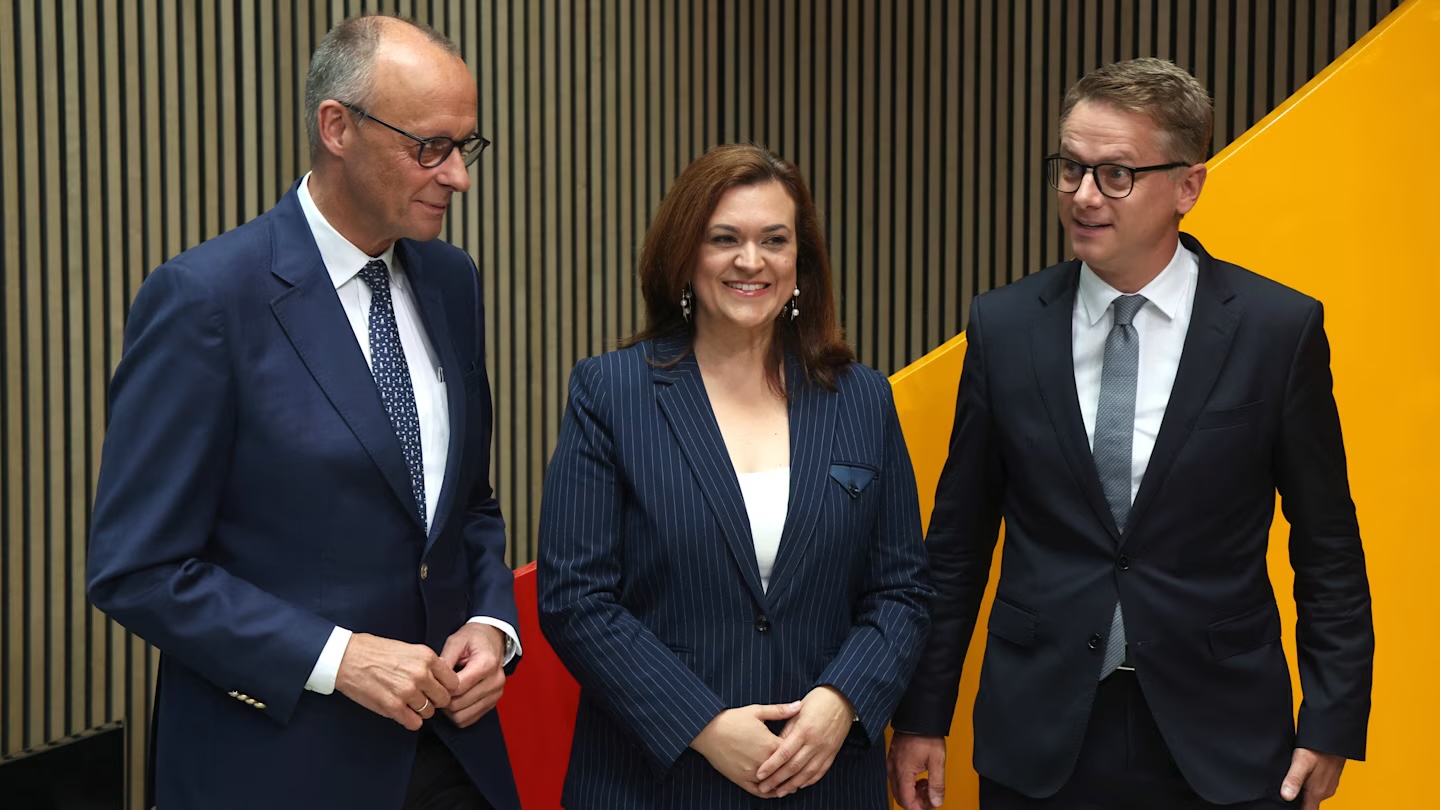
Friedrich Merz, a woman and Carsten Linnemann standing side by side in front of a wooden wall and a yellow panel
Friedrich Merz (left), a party colleague and Carsten Linnemann at a CDU event. Date and place not recorded in the supplied files. Photographer not recorded in supplied files
01 / Method

How to read this matrix

Political positions are claims about what should be done. They are presented here as documented positions — what Carsten Linnemann has said, written or voted for, or what programmes he led have stated — not as objective descriptions of what is right. Each topic carries a status label that distinguishes a political position from a policy that is now law or under implementation.

Three source layers are used, in this order of precedence. First, Linnemann's own documented statements: Bundestag speeches, his first speech as Federal Minister of Health on 10 September 2026, the government question time on 23 September 2026, and interviews reproduced by official bodies. Second, the CDU's 2024 basic programme In Freiheit leben. Deutschland sicher in die Zukunft führen, adopted on 7 May 2024 after a drafting process he chaired, and the economic programme Agenda 2030 adopted by the CDU federal executive in January 2025. Third, the coalition agreement Verantwortung für Deutschland signed by CDU, CSU and SPD on 5 May 2025, which binds him as a member of the government since 29 July 2026.

Criticism is attributed to named critics wherever it is documented. Where a topic draws more general debate, the criticism cell describes the main lines of argument and who advances them. The full treatment of contested statements is on the criticism and controversies page.

  • Political position
  • Proposed
  • In implementation
  • In force
  • Open question
Topics
13
Cells per topic
7
Programme chaired
CDU basic programme, adopted 7 May 2024
Current office
Federal Minister of Health since 29 July 2026

Role boundariesAs health minister he speaks for the federal government on health and long-term care only. Positions on tax, migration, security or Europe date from his time as MIT chair (2013–2021), deputy party chair and CDU Secretary-General (July 2023 – July 2026).

02 / Health and the economy

Health, economy, Mittelstand, labour, social policy

The fields in which his record is densest and most directly documented.

01

Health

In implementation

Position

In his first Bundestag speech as minister (10 September 2026) he set out three guiding principles: reliable care (patients must reach the right place quickly), sound financing without ever-higher non-wage labour costs, and the person at the centre — doctors and nurses should spend time on patients rather than forms. He describes the German system as strong but in need of greater efficiency.

Context

He took office on 29 July 2026, succeeding Nina Warken, and inherited a hospital-reform amendment (KHAG, in force 15 April 2026), a pharmacy reform and the GKV contribution-stabilisation law passed on 10 July 2026. The average additional contribution actually charged by insurers stood at 3.13% on 1 January 2026 (BMG).

Policy objective

Stable contribution rates in 2027 and, in the longer term, falling rates; a binding primary-care system (draft promised for November 2026); emergency-care reform passed by the end of 2026; a structural reform of long-term care insurance. His stated ambition before the Health Committee on 23 September 2026 was das leistungsfähigste Gesundheitssystem der Welt (as summarised by the Bundestag press service).

Arguments

Health contributions are levied on wages, so cost growth in health is also a labour-cost problem. Better steering of patients (primary care, emergency triage) and less bureaucracy are presented as ways to improve care and contain costs at once. On prevention he told the Bundestag on 23 September 2026: „Die beste Gesundheitspolitik lässt Krankheiten gar nicht erst entstehen.“

Criticism

On his appointment, Green health politician Janosch Dahmen criticised that neither health-policy nor ministerial experience appeared to matter; Christine Vogler of the German Nursing Council said the change signalled no continuity (kma-online, ZDF, July 2026). Critics of labour-cost framing argue it risks underweighting quality of care.

Counterargument

Supporters, including Federal Medical Association president Klaus Reinhardt, saw a chance to set necessary course. Chancellor Merz pointed to his role in the 2025 coalition negotiations on health. Linnemann himself asked publicly for time and said he had great respect for the task.

Current status

Long-term care bill (PNOG) adopted by cabinet on 30 September 2026; emergency-care reform in parliament; primary-care draft and a "Spargesetz 2" announced; Schätzerkreis on 15 October 2026 will inform the 2027 additional contribution, which has not yet been set. See key priorities and health policy.

02

Economy

Political position

Position

As Secretary-General he presented the CDU's Agenda 2030 (January 2025), which set a target of at least 2% annual growth and called for lower taxes on income, more flexible working time and electricity prices at least 5 cents per kilowatt-hour lower. He described relief for the middle class as its core.

Context

Real GDP grew by 0.2% in 2025 after a contraction in 2024, according to Destatis; the federal government's spring 2026 projection expected +0.5% for 2026. An economist by training, he worked at Deutsche Bank Research and IKB Deutsche Industriebank before entering the Bundestag in 2009.

Policy objective

Restore growth through lower costs for companies and workers, fewer regulations and stronger incentives to work — a supply-side programme in which, in his framing, performance must pay again.

Arguments

High energy prices, taxes and bureaucracy are presented as the main brakes on investment. Lowering them is argued to raise growth and, in turn, the revenue base for social insurance.

Criticism

Opposition parties and many economists questioned how tax cuts of the scale envisaged in Agenda 2030 would be financed without spending cuts or new debt. The 2% growth target was widely described as ambitious against recent performance.

Counterargument

The CDU argued that growth itself would finance a large part of the relief and that the reforms would be phased in steps from 2026.

Current status

Parts entered the coalition agreement of 5 May 2025 in modified form; the four-step income-tax reform was not adopted as proposed. As health minister he has no economic-policy portfolio. Background: economic policy, growth and competitiveness.

03

Mittelstand

Political position

Position

As federal chair of the Mittelstands- und Wirtschaftsunion (MIT), 2013–2021, he consistently argued for small and medium-sized firms: lower tax and contribution burdens, less reporting and documentation, and flexible transitions into retirement.

Context

According to IfM Bonn, there were more than 3.5 million SMEs in Germany in 2024 — over 99% of private firms — employing just under 22 million people and training 68% of apprentices.

Policy objective

A regulatory and fiscal framework designed around firms without large compliance departments; the most visible result was the Flexi-Rente of 2016, which he championed as MIT chair.

Arguments

Fixed compliance costs weigh proportionally more on small firms; family-owned companies are presented as the backbone of employment and training in regions such as East Westphalia.

Criticism

Trade unions and the CDU's own social wing (CDA) have long argued that MIT positions prioritise employers' costs over employee protections, for example in debates on working-time flexibility.

Counterargument

MIT positions stress that jobs in small firms depend on their competitiveness, and that the Flexi-Rente extended choice for employees rather than reducing rights.

Current status

A long-standing political position. In health policy the same theme reappears as the promise to cut documentation duties for practices, pharmacies and care services. See Mittelstand and MIT.

04

Labour

In force (in part)

Position

In the Bundestag on 15 May 2025 he called for a change of course in labour-market and social policy: „Wer aber arbeiten kann, muss arbeiten gehen. Leistung muss sich auch für Ältere lohnen.“ He supports a weekly rather than daily maximum working time (Agenda 2030).

Context

The Federal Employment Agency counted 2.99 million registered unemployed (6.4%) and 660,000 registered vacancies in September 2026; 157 occupations were classed as shortage occupations in 2025.

Policy objective

Raise labour participation — of benefit recipients, older workers and people working part-time — to address skills shortages and stabilise the contribution base.

Arguments

Work incentives should be built into tax and benefit systems; the Aktivrente (tax-free earnings for people working past retirement age) is presented as the model.

Criticism

Unions, including the DGB, oppose a weekly maximum working time on health-and-safety grounds; social associations argue that the "work must pay" framing places responsibility on individuals for structural unemployment.

Counterargument

Proponents point out that the EU working-time directive already uses a weekly reference period and that flexibility can serve employees' preferences as well as employers'.

Current status

The Aktivrente has applied since 1 January 2026; the Neue Grundsicherung was passed on 5 March 2026. Working-time reform remains a position. See labour market.

05

Social policy

In force

Position

He was a leading advocate of replacing the Bürgergeld with a Neue Grundsicherung based on „Fördern und Fordern“ and priority for job placement. Ärzteblatt reported him saying in the debate: „Der Sozialstaat ist an einigen Stellen nicht mehr gerecht.“

Context

From May 2025 to July 2026 he was deputy chair of the CDU/CSU parliamentary group responsible for labour and social affairs. The first reading was on 15 January 2026; the Bundestag passed the law on 5 March 2026.

Policy objective

Faster placement into work, stricter consequences for missed appointments and refusal of work, and a system perceived as fair by both taxpayers and jobseekers.

Arguments

A welfare state should, in his words, get people back into work rather than administer unemployment; stricter conditionality is presented as restoring acceptance of the system.

Criticism

In the 5 March 2026 debate, Timon Dzienus (Greens) described it as institutionalised mistrust and Heidi Reichinnek (Left) as an attack on the welfare state (Bundestag text archive). In 2024, the Diakonie president Rüdiger Schuch disputed his figures on "total refusers".

Counterargument

The coalition argued that the reform restores the principle of mutual obligation and that most recipients are unaffected by sanctions because they cooperate.

Current status

Law; taking effect in stages from 1 July 2026. Detailed debate on the criticism page and in tax and social policy.

03 / The state and public finances

Bureaucracy, taxation, pensions, digitalisation, infrastructure

Long-running themes of his economic profile; the last two are documented mainly through programme texts.

06

Bureaucracy

Proposed (health)

Position

Reducing bureaucracy is a constant of his career. As minister he announced at the hospital summit on 22 September 2026 that a planned Bürokratierückbaugesetz should reduce duplicate inspections and introduce risk-oriented controls.

Context

The National Regulatory Control Council (NKR) estimated the bureaucracy costs of businesses from information obligations at €64 billion a year in 2025, while recording a fall in annual compliance costs of about €3.2 billion between July 2024 and June 2025.

Policy objective

More time for patients and care: in his words, doctors and nurses should not spend their time on forms.

Arguments

Duplicate audits and documentation absorb scarce skilled labour; risk-based control concentrates oversight where problems are likely.

Criticism

When the coalition loosened supply-chain reporting duties in 2025, Germanwatch (Cornelia Heydenreich) argued that it created legal uncertainty rather than relief. Patient advocates generally warn that fewer controls can weaken quality assurance.

Counterargument

Risk-based inspection is an established regulatory method; the stated aim is to remove duplication, not oversight as such.

Current status

No bill text published as of 8 October 2026. See bureaucracy reduction.

07

Taxation

Political position

Position

Agenda 2030 proposed a four-step income-tax reform from 2026 in which the top rate would start only at an income of €80,000. He has long criticised "cold progression" — tax increases caused by inflation.

Context

The general government deficit was 2.4% of GDP in 2025 (Destatis). Tax policy belongs to the finance ministry; as health minister he has no tax portfolio.

Policy objective

Relief for middle incomes and stronger incentives to work additional hours.

Arguments

Skilled workers reach high marginal rates early; lowering them is argued to reward work and overtime.

Criticism

Critics questioned the cost and noted that relief tied to higher thresholds benefits higher earners in absolute terms.

Counterargument

The CDU presented the reform as staged and partly self-financing through growth.

Current status

Position; not enacted in the form proposed. The Aktivrente tax exemption is the main tax element enacted in this period. See tax and social policy.

08

Pensions

In force

Position

He favours incentives to work longer voluntarily rather than a higher statutory retirement age. On 5 December 2025 he called the Aktivrente the most innovative element of the pension package and a paradigm shift, and said a pension commission must follow.

Context

The 2025 pension package fixed the pension level at 48% until 1 July 2031 (DRV). The contribution rate is 18.6% and is projected to rise to 19.9% in 2028 (DRV estimate via press). Federal subsidies to pension insurance totalled €93.2 billion in 2025.

Policy objective

Keep experienced workers in employment and stabilise contribution income; prepare structural reform through a commission.

Arguments

Since the 2016 Flexi-Rente, which he championed as MIT chair, he has argued that people who want to work longer should not face state obstacles.

Criticism

The Taxpayers' Association (Bund der Steuerzahler) criticised in September 2026 that the Aktivrente rewards work in retirement only for employees and excludes the self-employed, and announced a constitutional challenge. Whether the measure raises labour supply beyond those who would have worked anyway has not yet been evaluated.

Counterargument

Supporters argue that the measure is simple to administer (no application) and signals that work in old age is welcome.

Current status

Aktivrente in force since 1 January 2026 (up to €2,000 a month tax-free for employees past the standard retirement age). As health minister he told the Bundestag on 23 September 2026 that there would be no pension cuts for family caregivers. See pension policy.

09

Digitalisation

Inherited bills

Position

As minister he has committed to passing the digital-health bill GeDIG and the medical-registries law, both adopted by the cabinet before he took office (15 July and 11 March 2026), and listed them in the Health Committee on 23 September 2026. Beyond health, the CDU programme he chaired calls for a digital, citizen-friendly state; no detailed personal statements on general digital policy are documented.

Context

The electronic patient record (ePA für alle) became mandatory for providers on 1 October 2025; gematik reported about 73 million records and more than 100 million documents by April 2026.

Policy objective

Use digital infrastructure to steer patients better and reduce paperwork in practices and hospitals.

Arguments

Digital processes are presented as a precondition for primary-care steering and for freeing professional time.

Criticism

Data-protection advocates and some medical associations have raised security and usability concerns about the ePA rollout generally; specific criticism of his announced bill cannot be assessed until a draft is published.

Counterargument

The ePA is opt-out, so patients retain the right to object; the Health Data Use Act (GDNG) regulates secondary use.

Current status

Bill announced for debate in October 2026; no text published at the time of writing. See digital health.

10

Infrastructure

Programme position

Position

No detailed personal position on transport or energy infrastructure is documented in the research for this site. The CDU programme and Agenda 2030, which he presented, emphasise faster planning procedures and lower energy prices.

Context

In health, infrastructure means hospitals: the hospital transformation fund provides up to €50 billion for 2026–2035, with the federal share of €29 billion drawn from the special fund for infrastructure and climate neutrality.

Policy objective

(Programme) Faster approval procedures; (health) a hospital landscape restructured around service groups.

Arguments

Slow planning raises costs and delays investment; in hospitals, concentration is argued to improve quality.

Criticism

Hospital restructuring is contested by Länder and local communities fearing site closures.

Counterargument

Hospital planning remains a Länder responsibility; federal law sets quality criteria and funding.

Current status

Hospital reform is inherited and in force; no new infrastructure initiative of his own. See hospitals.

04 / Society, security, Europe

Migration, security, European policy

Fields in which documented personal positions are thinner; programme positions are labelled as such.

11

Migration

Political position

Position

In a March 2026 speech, per the Bundestag summary, he framed the aim as immigration into the labour market, not into the social systems. The 2024 programme proposes that asylum procedures be carried out in safe third countries and that all people living in Germany recognise a Leitkultur.

Context

In 2019 he co-edited the book Der politische Islam gehört nicht zu Deutschland; the same year he proposed later school entry for children without sufficient German, later clarifying that he meant language tests at age four.

Policy objective

Managed labour migration, early language acquisition and stricter asylum policy.

Arguments

Integration depends on language and work; public acceptance of migration depends on control.

Criticism

Refugee councils and church representatives criticised the third-country model in 2024; his 2019 school proposal was called "populist nonsense" by Karin Prien (CDU) and rejected by the Länder education ministers.

Counterargument

He argued that the school proposal aimed at early support, not exclusion; the CDU presents the third-country model as a humane alternative to dangerous crossings.

Current status

Programme position; migration is outside his ministerial remit. In health, foreign-trained physicians (16% of practising doctors in 2025, BÄK) are part of the workforce debate — see medical workforce.

12

Security

Programme position

Position

No specific personal statements on defence or internal security are documented in the sources used here. The CDU programme he chaired states that the suspension of conscription should be gradually reversed and turned into a compulsory "society year".

Context

As health minister he is responsible for health security: he announced a Gesundheitssicherstellungsgesetz (health-system resilience law) on 23 September 2026.

Policy objective

(Programme) Stronger defence readiness and civic service; (health) preparedness of the health system for crises.

Arguments

The changed security situation in Europe requires both military and civilian resilience, including hospitals and medicine supply.

Criticism

A compulsory service year is contested: critics argue that it encroaches on young people's freedom, and it would require a constitutional amendment because the Basic Law restricts compulsory service.

Counterargument

The programme presents service as a contribution to social cohesion as well as security.

Current status

Health-security bill announced, no text yet. See health security.

13

European policy

Programme position

Position

No detailed personal European-policy platform is documented. The CDU programme he chaired is pro-European and Atlanticist. His doctoral thesis dealt with international trade in transport services in the context of European integration. As minister he called foreign mail-order pharmacies' co-payment bonuses a distortion of competition: „Entweder dürfen es beide oder keiner.“

Context

Under EU free-movement rules, foreign mail-order pharmacies may offer bonuses that German pharmacies may not. The EU Health Data Space regulation applies in stages from 26 March 2027.

Policy objective

A level playing field between domestic and foreign providers; implementation of EU health-data rules.

Arguments

Unequal rules disadvantage local pharmacies that provide emergency and night services.

Criticism

Mail-order providers argue that their model lowers costs for patients; according to Pharmazeutische Zeitung (September 2026), the European Commission saw no breach of EU competition law.

Counterargument

The Commission also acknowledged concerns about unequal enforcement, which supporters of his position cite.

Current status

Open question at EU level. See pharmaceutical policy.

05 / Pattern

One thread across thirteen fields

Read together, the matrix shows a consistent organising idea: social insurance and public finances depend on the number of people in work and on what work costs. Labour, pensions, social policy and taxation are approached through incentives to work; health and care through the burden of contributions on wages. Bureaucracy reduction is the connecting instrument.

The same reading explains where his record is thin. Security and European policy are present mainly through the programme he chaired rather than through personal initiatives. Migration appears chiefly through integration and labour-market framing — and through the 2019 controversies documented elsewhere on this site.

Positions are documented here as claims to be tested, not as conclusions to be adopted.