Economy · Labour market
The labour market: high employment, rising slack, shrinking workforce
Germany has more people in work than at almost any time in its history, a growing number without a job, and a working-age population that will shrink. All three are true at once — and each supports a different policy argument.
- Employed persons (Aug 2026)
- 45.58m
- Employees subject to social insurance (Jul 2026)
- 34.68m
- Unemployment rate, BA (Sep 2026)
- 6.4%
- Unemployment rate, ILO (Aug 2026)
- 4.3%
- Registered vacancies (Sep 2026)
- 660,000
01 / Economic analysis
Two unemployment rates, one labour market
Germany publishes two unemployment rates, and they differ by about two percentage points. The Federal Employment Agency (BA) counts people registered as unemployed at employment agencies and job centres: 2,994,000 in September 2026, a rate of 6.4% and 40,000 more than a year earlier. Destatis publishes the internationally comparable ILO measure, based on a survey of whether people are without work, actively looking and available: 4.3% in August 2026.
The gap arises because the registered count includes some people who work a few hours a week or who are not immediately available, while the ILO count includes some who look for work without registering. Neither figure is “the real one”. International comparisons should use the ILO rate; domestic policy debates generally use the BA rate.
A wider measure, Unterbeschäftigung (underemployment), adds people in labour-market programmes and short-term incapacity: 3,615,000 in September 2026. The BA summed up the autumn of 2026 as a season that began without momentum, with the economic improvement not yet reaching the labour market.
How much Germany works
The number of people in work has stopped rising; the number of hours worked per person has been falling for a long time.
Full-time and part-time employees
SourceIAB working-time accounts for 2025, published 3 Mar 2026 (as reported by apotheke adhoc). Part-time rate: 39.9%, a record.
The rise of part-time work is the single most important fact for understanding German labour supply. It reflects women’s much higher labour-force participation compared with a generation ago — many of whom work part-time — but also the availability of childcare and long-term care, the tax treatment of second earners, and personal preference. The IAB’s Enzo Weber has argued that part-time work has so far been a net gain for employment, while the larger untapped potential lies in better career development for women.
03 / Economic analysis
Shortages and slack at the same time
In September 2026 employers had 660,000 vacancies registered with the BA — 30,000 more than a year earlier — while almost three million people were registered as unemployed. This is not a contradiction. Vacancies and jobseekers often do not match in qualification, region or working hours.
The BA’s 2025 shortage analysis, published on 2 September 2026, identified 157 shortage occupations, down from 163 a year earlier. The strongest shortages are in nursing and health occupations, construction and skilled trades, and among cooks, professional drivers and educators. According to the BA, only around one in five unemployed skilled workers was looking for work in a shortage occupation.
Immigration is increasingly filling the gap. The BA reports that the foreign share of employment in shortage occupations doubled from 7% in 2014 to about 14% in 2025. In nursing, employment of German nationals fell by 5,000 between June 2024 and the reporting period while employment of foreign nationals rose by 46,000. That link makes the labour market directly relevant to the health ministry; see medical workforce and nursing.
Insured jobs, flexible work and productivity
Three slower-moving trends behind the monthly headlines.
Insured employment is falling slightly
Employment subject to social insurance stood at 34.68 million in July 2026, 84,000 fewer than a year earlier, and total employment at 45.58 million in August 2026, 236,000 fewer. After years of growth, both measures are now lower than a year earlier, in line with the weak economy. Short-time work, at 118,000 recipients in July 2026, remains far below crisis levels.
Flexible work and working time
The German Working Time Act limits the working day to eight hours, extendable to ten if the average is maintained. Employers’ associations argue this is too rigid for modern work patterns; unions argue it is a basic health protection. The draft amendment circulated in June 2026 would allow a weekly limit of 48 hours instead — but, according to legal commentators, only for employers covered by collective agreements. The final shape is open.
Productivity per hour
Output per hour worked rose by 0.4% in 2025, output per person by 0.2% (Destatis). With fewer hours available in future, the long-term standard of living depends more on productivity than on headcount. Investment, digitalisation and better matching of people to jobs all feed into it; shorter commuting and better health do too, which is one reason labour-market and health policy overlap.
The workforce of 2070
The 16th coordinated population projection (Destatis, 11 December 2025) gives a range, not a point forecast. The outcome depends mainly on migration and birth rates.
Working-age population, aged 20–66
SourceDestatis, press release 446/2025, 16th coordinated population projection.
Even in the most favourable variant, the population of working age shrinks by about six million by 2070; in the least favourable, by fourteen million. Meanwhile the number of people aged 67 and over rises to between 20.5 and 21.3 million by 2038.
Three levers can soften this: more immigration, higher participation (especially of women, older people and the long-term unemployed), and longer hours for those already working. A fourth — higher productivity per hour — determines whether a smaller workforce can still raise living standards. In 2025 output per hour worked rose by only 0.4% (Destatis).
The full chain from ageing to public finances is on the demographic change page.
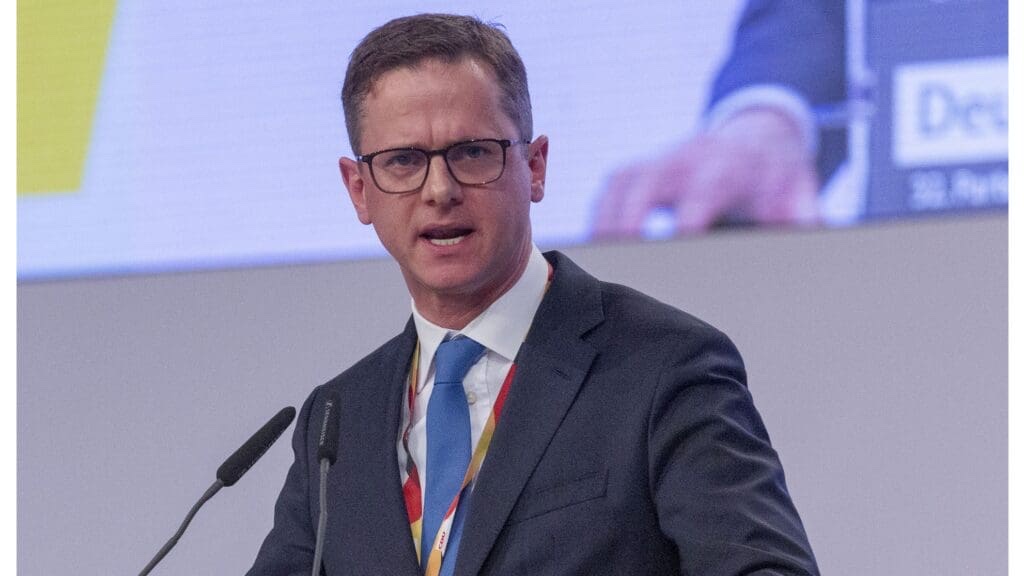
Linnemann’s labour-market positions
From May 2025 to July 2026 he was deputy chair of the CDU/CSU parliamentary group with responsibility for labour and social affairs. Positions are documented from Bundestag speeches.
Neue Grundsicherung
Replaces the Bürgergeld. Passed by the Bundestag on 5 March 2026 (320 yes, 268 no, 2 abstentions, per the Bundestag text archive); takes effect from summer 2026. Priority for placement in work, graduated benefit reductions for missed appointments, age-tiered protected assets.
Aktivrente
Up to €2,000 a month of employment income tax-free for employees past the statutory retirement age, from 1 January 2026. Linnemann called it the most innovative element of the 2025 pension package.
Weekly maximum working time
A CDU Agenda 2030 demand and coalition plan. A draft amendment to the Working Time Act circulated in June 2026, reportedly limited to firms covered by collective agreements. Not yet adopted by the cabinet.
Labour migration
In a March 2026 speech he framed the goal as immigration into the labour market rather than into the social-security systems (Bundestag summary).
„Es braucht also einen Politikwechsel in der Arbeitsmarkt- und Sozialpolitik.“
„Im Kern geht es darum, dass wir ein gerechtes System bekommen.“
Where should labour-market policy push?
The arguments below were made in the Bundestag debates on the Neue Grundsicherung and in the wider public debate.
Activation and incentives (coalition position)
- With 157 shortage occupations and a shrinking workforce, every person who can work should be helped and expected to do so (“Fördern und Fordern”).
- Faster placement prevents long-term unemployment from becoming entrenched.
- Flexible weekly working time suits sectors with uneven workloads and employees who want longer days in exchange for shorter weeks.
- The SPD argued that the reform strengthens personal responsibility while committing about €4bn to qualification and youth support, and that 97% of recipients are unaffected by the new sanctions.
Protection and structural barriers (opposition)
- The Greens argued the law stigmatises poverty, that fast placement into precarious jobs is ineffective, and that households with children should be exempt from sanctions.
- The Left called it the largest attack on the welfare state and warned of homelessness through tighter housing-cost rules.
- The AfD argued the measures did not go far enough and called for compulsory community work.
- Unions defend the daily limit of the eight-hour day as health protection.
A related controversy: in July 2024 Linnemann spoke of a six-figure number of people unwilling to work. Welfare organisations disputed the figure, citing BA data showing that total refusal is rare. See criticism and controversies.
07 / Why it matters for health and pensions
Employment is the base of social insurance
Pension, health, long-term care and unemployment insurance are all financed mainly from contributions on wages. When employment subject to social insurance falls — in July 2026 it was 84,000 lower than a year earlier, at 34.68 million — every branch loses revenue at once. When it rises, every branch gains.
This is the economic thread that runs from Linnemann’s labour-market work to his current office. A health minister who wants stable contribution rates depends on a labour market that keeps people in insured employment, and on a health system that keeps workers healthy enough to stay there. See statutory health insurance and pension policy.
- Jobs34.68m insured employees
- WagesContribution base
- Contributions≈42% of gross pay, shared
- InsurancePension, health, care, unemployment
Sources & further reading
- Federal Employment Agency — The labour market in September 2026 (30 Sep 2026)
- Destatis — ILO unemployment and employment, August 2026 (30 Sep 2026)
- Destatis — Gross domestic product 2025 (employment, productivity) (15 Jan 2026)
- apotheke adhoc — IAB: part-time rate rises to 39.9% in 2025 (3 Mar 2026)
- Statistical Offices — Employment rate, 20 to 64-year-olds
- Federal Employment Agency — Skilled workers remain scarce (shortage analysis 2025) (2 Sep 2026)
- Destatis — 16th coordinated population projection (11 Dec 2025)
- Deutscher Bundestag — Neue Grundsicherung passed (5 Mar 2026)
- Deutscher Bundestag — Debate on labour-market and social policy (15 May 2025)
- Deutscher Bundestag — Pension package and Aktivrente (5 Dec 2025)
- Otto Schmidt Arbeitsrecht-Blog — Draft amendment to the Working Time Act (2026)
- evangelisch.de — Diakonie disputes Linnemann’s figures (29 Jul 2024)