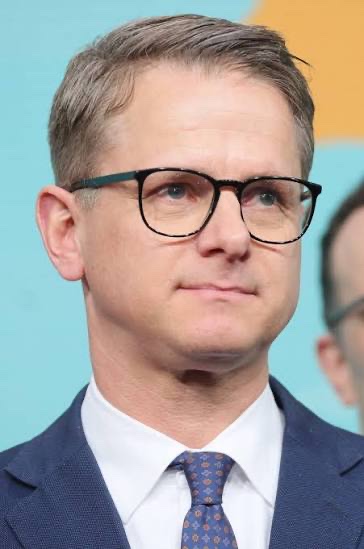
Carsten Linnemann has won the Paderborn constituency directly at five consecutive Bundestag elections. The seat has changed its number, its name and its boundaries along the way; the result has not changed.
Constituency
Wahlkreis 136 Paderborn (since 2025)
Previously
Wahlkreis 137 (2009–2021)
Member since
2009 — direct mandate
2025 first vote
45.5% (86,833 votes)
01 / Numbering
137, then 136: a short history of the seat’s name
Why the constituency is “Wahlkreis 136” today but was not when he first won it.
Germany’s 299 Bundestag constituencies are numbered consecutively from north to south, starting in Schleswig-Holstein. When boundaries are redrawn anywhere earlier in the sequence, numbers further down shift. That is what happened to Paderborn.
From 2009 to 2021 Linnemann’s seat was Wahlkreis 137. At the 2013 and 2017 elections it carried the name Paderborn – Gütersloh III, reflecting that part of the neighbouring district of Gütersloh was included. For 2021 the boundaries were changed and the seat was named simply Paderborn, still under the number 137. At the federal election of 23 February 2025 the same seat appeared as Wahlkreis 136 Paderborn.
The practical consequence is a rule of accuracy used throughout this site: his constituency is described as Wahlkreis 137 for 2009–2021 and Wahlkreis 136 from 2025, never as “Wahlkreis 136 since 2009”. Because boundaries changed, percentage results are also not strictly comparable from one election to the next.
2009
WK 137 Paderborn
First win.
2013
WK 137 Paderborn – Gütersloh III
Name reflects a cross-district seat.
2017
WK 137 Paderborn – Gütersloh III
Unchanged name.
2021
WK 137 Paderborn
Boundaries changed.
2025
WK 136 Paderborn
Renumbered.
02 / Electoral history
Results 2009–2025
Linnemann’s first-vote (constituency) results, with the source for each year.
First votes for Carsten Linnemann (CDU), Paderborn constituency
Election
Constituency
First-vote share
Votes
Source
27 Sep 2009
WK 137 Paderborn
52.1%
—
abgeordnetenwatch (single source; official page not retrieved)
22 Sep 2013
WK 137 Paderborn – Gütersloh III
59.1%
102,867
IT.NRW, official results
24 Sep 2017
WK 137 Paderborn – Gütersloh III
53.3%
99,004
IT.NRW, official results
26 Sep 2021
WK 137 Paderborn (new boundaries)
47.9%
84,669
IT.NRW, official results
23 Feb 2025
WK 136 Paderborn
45.5%
86,833
Bundeswahlleiterin
Sources: IT.NRW (wahlergebnisse.nrw) result sheets for Wahlkreis 137 (2017 sheet includes 2013 comparison; 2021 sheet); Bundeswahlleiterin, Wahlkreis 136, 2025; abgeordnetenwatch for 2009.
First-vote share over five elections
Unit: % of valid first votes · 2009–2025 · boundaries not constant
52.1
59.1
53.3
47.9
45.5
20092013201720212025
Sourceabgeordnetenwatch (2009, single source); IT.NRW (2013–2021); Bundeswahlleiterin (2025).
03 / 2025 in detail
Federal election of 23 February 2025, Wahlkreis 136
Official results published by the Federal Returning Officer (Bundeswahlleiterin).
231,585Eligible voters in Wahlkreis 136 Paderborn2025 · Bundeswahlleiterin
83.1%Turnout — 192,337 voters, +6.0 points on 20212025 · Bundeswahlleiterin
45.5%Linnemann’s first-vote share — 86,833 of 190,870 valid first votes (−2.4 points)2025 · Bundeswahlleiterin
27.2ptsLead over the runner-up — 51,905 votes2025 · calculated from Bundeswahlleiterin data
First votes (constituency candidates)
Unit: % of valid first votes · WK 136 · 2025
Linnemann (CDU)45.5%
Lex (AfD)18.3%
SPD15.2%
Greens10.6%
Left6.3%
FDP2.4%
SourceBundeswahlleiterin, Wahlkreis 136 Paderborn, final result 2025.
Second votes (party lists)
Unit: % of valid second votes · WK 136 · 2025
CDU37.3%
AfD18.9%
SPD13.8%
Greens11.5%
Left7.1%
FDP4.2%
BSW4.0%
SourceBundeswahlleiterin, Wahlkreis 136 Paderborn, final result 2025. CDU: 71,373 second votes (+4.3 points).
Two readings of the 2025 result stand side by side. On the one hand, Linnemann’s personal vote share fell for the third election running, to 45.5%, and the AfD candidate came second with 18.3%. On the other, his lead of more than 27 percentage points remained a wide margin in a multi-party field, and he won more first votes in absolute terms (86,833) than in 2021 (84,669), helped by a sharp rise in turnout.
Turnout matters for that comparison. At 83.1%, participation in Wahlkreis 136 was six points higher than in 2021, so a lower percentage could coexist with a higher absolute number of votes. Across Germany, the early election of February 2025 followed the collapse of the previous coalition and produced unusually high turnout.
The gap between first and second votes is also telling. Linnemann won 45.5% as a candidate while the CDU list won 37.3% in the same constituency — a personal premium of about eight points, which suggests that some voters who backed another party with their second vote supported him personally. Nationally, the CDU and CSU together won 28.6% of the second vote in 2025, so Paderborn remains well above the Union’s national average.
04 / Geography
The district of Paderborn: a schematic
The ten municipalities of the district (Kreis) of Paderborn, around which the constituency is built. Positions are approximate; this is not a map.
Schematic only. For official boundaries, see the Bundeswahlleiterin’s constituency description.
Ten municipalities
The district of Paderborn comprises the city of Paderborn and nine further municipalities: Altenbeken, Bad Lippspringe, Bad Wünnenberg, Borchen, Büren, Delbrück, Hövelhof, Lichtenau and Salzkotten. It forms part of East Westphalia-Lippe and of the administrative region of Detmold in North Rhine-Westphalia.
Altenbeken, in the east, is where Linnemann sat on the municipal council from 2004 to 2008 — see local politics. Two of the towns carry the prefix “Bad”, which in Germany denotes an officially recognised spa resort. Paderborn itself is the district seat and the region’s main centre for administration, higher education and services.
BoundariesThe exact municipalities assigned to the constituency at each election are set in the federal electoral law. The 2013 and 2017 seat also included part of the district of Gütersloh. Readers needing the legal definition should consult the Bundeswahlleiterin.
05 / Local economy
Mittelstand, technology and a university city
An institutional description. Local economic statistics are not given because none were verified for this site.
Owner-managed firms
Like much of East Westphalia-Lippe, the Paderborn area is characterised by family-owned and owner-managed companies in manufacturing, technology, trades and services — the Mittelstand. Nationally, small and medium-sized enterprises make up more than 99% of private-sector firms (IfM Bonn, 2024). See Mittelstand.
Computing and engineering
Paderborn’s modern economic profile is associated with computing: Heinz Nixdorf built his computer company in the city, and the Heinz Nixdorf MuseumsForum documents the history of information technology. Applied research is represented by the Fraunhofer Institute for Mechatronic Systems Design (IEM), on whose board of trustees Linnemann sat from 2016 to June 2026.
Higher education
Paderborn University and the private FHDW, where Linnemann studied business administration, make the city a centre of higher education for the region. Universities link the local labour market to research and to the supply of skilled graduates — a recurring theme in debates on competitiveness.
06 / Infrastructure
Roads, rail and air
The transport links that connect the district to the Ruhr, Kassel and Bielefeld.
Motorways
The A33 links Paderborn northwards towards Bielefeld and Osnabrück; the A44 between the Ruhr and Kassel crosses the south of the district. Both matter for the logistics of manufacturing firms that supply customers across Germany.
Rail
Paderborn lies on the main line between Hamm and Kassel. Altenbeken is a historic railway junction, known for its large stone viaduct. Rail reliability and investment fall under federal transport policy and the federally owned railway.
Airport
Paderborn/Lippstadt Airport is located within the district, near Büren. Regional airports of this size have faced questions about their business model across Germany; this page makes no claim about its finances.
07 / Healthcare
How health care is organised in the district
Who is responsible for what — relevant now that the constituency’s member is Federal Minister of Health.
01
Hospitals
Who plans
The state of North Rhine-Westphalia, through its hospital plan, decides which hospitals provide which services.
Who pays
Running costs are paid by the health insurance funds; investment costs are a Länder responsibility.
Federal role
The federal government sets the legal framework, including the 2025 hospital reform and its 2026 amendment. See hospitals.
02
Doctors’ practices
Who organises
The Association of Statutory Health Insurance Physicians of Westphalia-Lippe (KVWL) is responsible for ensuring ambulatory care in the region.
Who pays
Statutory health insurance, via negotiated budgets.
Federal role
The planned primary-care system announced for November 2026 would change how patients access specialists. See health system.
03
Spa and rehabilitation
Where
The spa towns of Bad Lippspringe and Bad Wünnenberg host spa and rehabilitation facilities.
Who pays
Depending on the case, pension insurance (for working-age rehabilitation) or health insurance.
Link to policy
Rehabilitation sits at the junction of health and labour-market policy — keeping people able to work. See prevention.
04
Public health and care
Public health
The district runs the local public health office (Gesundheitsamt).
Long-term care
Care services are financed largely through long-term care insurance; most people in need of care nationally are cared for at home (86%, Destatis, Dec 2023).
Federal role
The care reform (PNOG) adopted by the cabinet on 30 September 2026 applies nationwide. See nursing.
A minister who is also a constituency member
Federal ministers in Germany normally keep their Bundestag seats. Linnemann therefore continues to represent Paderborn as its directly elected member while serving as Federal Minister of Health. His long-standing civic roles in the city — vice-president of SC Paderborn 07 from 2018 to August 2026, trustee of Fraunhofer IEM from 2016 to June 2026, chair of the advisory board of Neue Mobilität Paderborn — reflect the local rooting of his career. See professional career.
Office addresses listed on government pages refer to the Federal Ministry of Health in Bonn and Berlin and are not his personal constituency offices; they are not reproduced here. For contact routes, see contact.
Five elections, three names, two numbers — and one directly elected member.