Historical office · July 2023 – July 2026

CDU Secretary-General, 2023–2026: programme, campaign, coalition

For three years Carsten Linnemann ran the CDU’s federal headquarters. In that time the party adopted a new basic programme, won the February 2025 federal election, negotiated a coalition with the SPD and pushed through the replacement of Bürgergeld — before he left party office to become Federal Minister of Health.

Office
Secretary-General of the CDU Germany
Term
July 2023 – 27 July 2026
Party chair
Friedrich Merz
Successor
Franziska Hoppermann
01 / The office

What a CDU Secretary-General does

The second most visible post in the party — part manager, part campaign chief, part chief spokesperson.

The Secretary-General (Generalsekretär) is proposed by the party chair and elected by the federal party congress. He or she directs the federal party headquarters, the Konrad-Adenauer-Haus in Berlin, with its departments for organisation, campaigns, communications and policy planning. The Secretary-General sits in the presidium and the federal executive and, in election years, is responsible for running the national campaign.

Two features of the role are important for understanding Linnemann’s tenure. First, it is a party office, not a parliamentary or government one: its resources come from the party, and its task is to win elections and hold the organisation together. Second, the Secretary-General is traditionally the party’s sharpest public voice — expected to attack opponents and sharpen positions so that the chair can appear statesmanlike. Several of Linnemann’s most criticised statements fall into that pattern.

Merz appointed Linnemann in July 2023, replacing Mario Czaja; the Konrad Adenauer Foundation gives 12 July 2023 as the date. At the 36th federal party congress in May 2024 the delegates confirmed him with 91.37% of the votes, according to the Foundation.

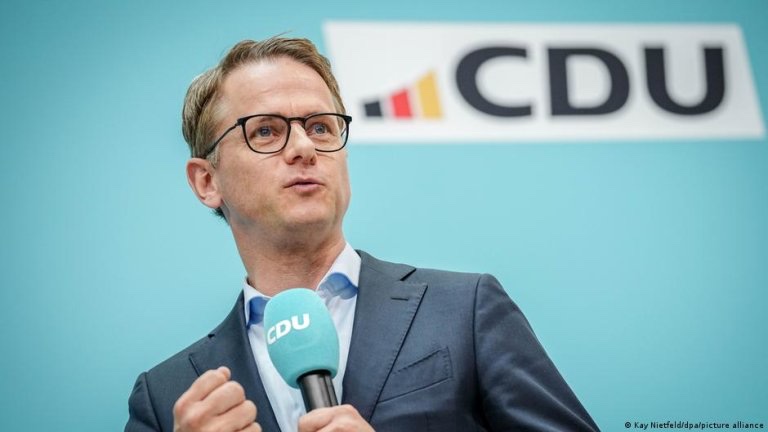
Carsten Linnemann speaking into a CDU microphone in front of a CDU logo on a turquoise backdrop
As CDU Secretary-General, speaking in front of the party logo.
02 / The tenure in figures

Three years, four markers

Every figure is taken from an official or primary source.

91.37%Delegates’ votes confirming him as Secretary-General at the 36th party congressMay 2024 · Konrad-Adenauer-Stiftung
28.6%CDU/CSU second-vote share in the federal election (CDU 22.6% + CSU 6.0%)23 Feb 2025 · Federal Returning Officer
144pp.Length of the coalition agreement “Verantwortung für Deutschland”Signed 5 May 2025 · ZDF
320yesVotes for the Neue Grundsicherung in the final reading (268 against, 2 abstentions)5 Mar 2026 · German Bundestag

On the March 2026 vote: the Bundestag’s recorded vote shows 320 in favour; some summaries report 321. This page follows the Bundestag text archive.

03 / Chronology

From appointment to transition

  1. Jul 2023

    Appointed Secretary-General

    Merz brings in his deputy chair and programme-commission chair to run the party headquarters, with the CDU in opposition.

  2. 7 May 2024

    New basic programme

    The 36th party congress in Berlin adopts “In Freiheit leben. Deutschland sicher in die Zukunft führen”, drafted under his chairmanship of the programme commission, and confirms him in office.

  3. Jul 2024

    “Total refusers” remarks

    In an interview with the Funke newspapers he says a six-figure number of Bürgergeld recipients are fundamentally unwilling to work and should lose benefits entirely; welfare organisations and unions dispute the figure (see below).

  4. 10–11 Jan 2025

    Agenda 2030

    The federal executive adopts the CDU’s economic programme for the snap election in Hamburg.

  5. 23 Feb 2025

    Federal election

    The CDU/CSU comes first with 28.6% of second votes. Linnemann wins Paderborn with 45.5% of first votes.

  6. 15 Apr 2025

    Declines a cabinet post

    Announces he will remain Secretary-General instead of joining the government.

  7. 5–6 May 2025

    Coalition and chancellor

    Coalition agreement signed on 5 May; Merz elected chancellor in the second ballot on 6 May. Linnemann becomes deputy chair of the CDU/CSU parliamentary group in May.

  8. 5 Dec 2025

    Pension package with Aktivrente

    Speaks for the group; the package passes the Bundestag.

  9. 5 Mar 2026

    Neue Grundsicherung adopted

    The replacement of Bürgergeld passes; it takes effect in stages from 1 July 2026.

  10. 27 Jul 2026

    Hands over

    Franziska Hoppermann is elected Secretary-General; two days later Linnemann becomes Federal Minister of Health.

04 / Party and message

Organisation, communication, programme

Three tasks of the headquarters and how they were approached in 2023–2026.

Party organisation

On declining a ministry in April 2025, Linnemann explained that he and his colleagues had worked hard over three years to rebuild the CDU, that the process was not yet complete and that he wanted to continue it (ZDF, translated). The statement shows how he saw the job: less as a springboard than as a project of internal renewal after the 2021 defeat, the party’s worst result to that date.

Communication

His public style favoured short, plain-language slogans: “performance must pay again”, Fördern und Fordern, and the call to “just get on with it” (einfach mal machen), which is also the name of a podcast he hosts (single source). Supporters saw clarity; critics saw simplification, particularly in debates on welfare recipients.

Programme

The 2024 basic programme and the 2025 Agenda 2030 gave the campaign a documented base — something the party had lacked in 2021. The programme process, which he led from 2022, involved the membership in drafting. Details are on the CDU leadership page.

05 / Electoral strategy

The 2025 federal election

The snap election followed the collapse of the SPD-Green-FDP coalition in November 2024. As Secretary-General, Linnemann was responsible for the CDU campaign.

Second-vote shares, Bundestag election 23 February 2025

Unit: % of valid second votes · Official final result · Parties above 5%

  • CDU/CSU28.6%
  • AfD20.8%
  • SPD16.4%
  • Greens11.6%
  • Left8.8%

SourceFederal Returning Officer, final result. CDU 22.6% + CSU 6.0%; many outlets round the union total to 28.5%.

The CDU/CSU became the strongest force and the basis of the next government. Measured against its own ambitions and against polling earlier in the campaign, the result was nonetheless seen by many commentators as modest: it was the union’s second-weakest result in a federal election, ahead only of 2021, while the AfD doubled its share.

The campaign’s economic message — growth, tax relief for middle incomes, lower energy prices, less bureaucracy — came directly from the Agenda 2030. Migration became the other dominant theme, especially in the final weeks, and the CDU/CSU’s handling of it was the subject of intense controversy that this page does not attempt to adjudicate.

In his own constituency Linnemann received 45.5% of first votes, 2.4 points less than in 2021, but more than twice the share of the runner-up. See the constituency page.

06 / Coalition

The coalition, and the ministry he turned down

The CDU, CSU and SPD signed their coalition agreement, Verantwortung für Deutschland (“Responsibility for Germany”), in Berlin on 5 May 2025. At 144 pages it covered the economy, migration, social policy, defence and health. Friedrich Merz was elected chancellor the following day in the second ballot. According to Merz, Linnemann handled the health sector in the coalition negotiations — a point he cited when appointing him health minister fourteen months later.

On 15 April 2025, before the cabinet was named, Linnemann announced that he would not join the government. ZDF reported that he had been tipped for the economy ministry and had reportedly wanted labour and social affairs, which went to the SPD under the coalition deal. He chose to remain Secretary-General, explaining that the rebuilding of the CDU was not yet complete. The Pharmazeutische Zeitung later recalled his remark that being a minister was not worth it just to have it appear on Wikipedia (paraphrase).

In May 2025 he additionally became a deputy chair of the CDU/CSU parliamentary group, responsible for labour and social affairs, employees, sport and volunteering — giving the party headquarters a direct line into the group’s handling of the coalition’s main social-policy projects.

„…die CDU wieder aufzubauen. Dieser Prozess ist noch nicht abgeschlossen.“

Carsten Linnemann · 15 April 2025 · on declining a cabinet post (fragment as reported) · English: “…to rebuild the CDU. This process is not yet complete.” · ZDF
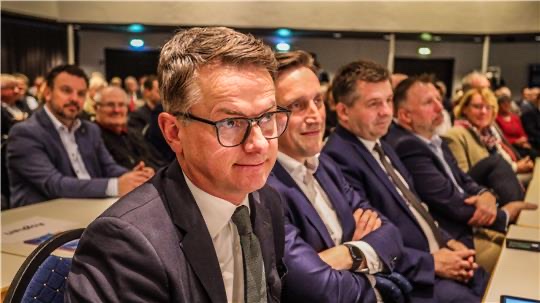
Carsten Linnemann seated in the audience at an event in Goslar
As CDU Secretary-General, in the audience at an event in Goslar.
07 / Positions

Documented positions as Secretary-General

Presented as positions he advanced on behalf of the CDU — not as objective assessments — together with the main criticism.

01

Economic reform and competitiveness

Political position

Position

At least 2% growth; four-step income-tax reform with the top rate from €80,000; electricity at least 5 ct/kWh cheaper (Agenda 2030). Relief for the middle class as the core.

Criticism

Opponents and several economists questioned the financing of the tax cuts and the realism of the growth target.

Status

Partly reflected in the 2025 coalition agreement; see growth and competitiveness.

02

Labour and working time

Political position

Position

A weekly instead of a daily maximum working time; “performance must pay”, including for older people; the Aktivrente allowing tax-free earnings for those working beyond pension age.

Criticism

Objections raised in public debate included the risk that a weekly limit weakens health protection at work, and that the Aktivrente benefits mainly those physically able to keep working.

Status

Aktivrente adopted as part of the pension package on 5 December 2025. See work and performance.

03

Social policy and basic income support

Political position

Position

Replace Bürgergeld with a new basic income support system based on Fördern und Fordern, priority on job placement, tougher consequences for refusing work.

Criticism

Welfare associations, unions, Greens and the Left argued that the reform stigmatised recipients and that the number of “total refusers” was small.

Status

Neue Grundsicherung passed on 5 March 2026; phased entry into force from 1 July 2026.

04

Migration

Political position

Position

In the March 2026 debate he framed the aim as immigration into the labour market rather than into the social systems (Bundestag summary).

Criticism

Critics argued that linking migration to welfare abuse fuels prejudice; earlier, his co-edited 2019 book on political Islam was criticised by some reviewers for right-populist tones.

Status

A contested field throughout his tenure; see political positions.

05

Bureaucracy reduction

Political position

Position

Fewer reporting and documentation duties for firms and professionals; a recurring theme since his MIT years.

Criticism

A common objection is that some of what is labelled bureaucracy protects consumers, workers or the environment, so cuts need case-by-case scrutiny.

Status

Continued as minister, e.g. the announced bureaucracy-reduction law for the health sector. See bureaucracy reduction.

08 / Flagship reform

From Bürgergeld to the Neue Grundsicherung

The policy most associated with his tenure, traced step by step.

Diagnosis

Linnemann argued that the welfare state was “no longer fair in some places” — „Der Sozialstaat ist an einigen Stellen nicht mehr gerecht“ — towards those who finance it.

Campaign

Abolishing Bürgergeld in its existing form became a central CDU demand in the 2025 campaign.

Coalition

The coalition agreement of May 2025 committed the CDU/CSU and SPD to a new basic income support system.

First reading

15 January 2026: Linnemann speaks of a fair system and a return to support-and-obligation with priority on placement.

Adoption

5 March 2026: passed with 320 votes to 268, with 2 abstentions.

Implementation

Takes effect in stages from 1 July 2026, administered by job centres.

„Wir müssen alles dafür tun, Menschen wieder in Arbeit zu bringen, anstatt Arbeitslosigkeit zu verwalten.“

Carsten Linnemann · Bundestag debate on the Neue Grundsicherung, as reported by Deutsches Ärzteblatt in connection with the 5 March 2026 vote (a similar line appears in the 15 January 2026 first reading) · English: we must do everything to bring people back into work instead of administering unemployment · Ärzteblatt
09 / Criticism

The “total refusers” controversy

Bürgergeld remarks, late July 2024

Contested

Background

In an interview with the Funke media group, Linnemann said that a six-figure number of Bürgergeld recipients were fundamentally unwilling to work and that their benefits should be cut entirely.

Linnemann’s position

Those who can work but refuse should not be supported by the community; the system must be fair to those who pay for it.

Criticism

Diakonie president Rüdiger Schuch called his figures simply false, pointing to Federal Employment Agency data showing fewer than 1% are total refusers. DGB board member Anja Piel cited constitutional limits and spoke of a contemptuous attitude; Christian Bäumler of the CDU’s employee wing also objected.

Counterargument

Supporters argued that even a small number of refusals undermines acceptance of the system, and that sanctions are needed as a signal.

Status

The 2026 reform tightened rules for refusing work; constitutional limits on full benefit withdrawal remain a subject of legal debate. See criticism and controversies.

10 / Transition

July 2026: from party headquarters to the ministry

A cabinet reshuffle triggered by a change at the top of the parliamentary group.

  1. mid-Jul 2026

    Spahn resigns as group chair

    Jens Spahn steps down as chair of the CDU/CSU parliamentary group; ZDF reports the controversy over his use of surrogacy in the US and the late communication about it as the cause. (One secondary source gives 18 July; not independently verified.)

  2. 22 Jul 2026

    Frei proposed

    Merz and Söder propose the head of the Chancellery, Thorsten Frei, as the new group chair.

  3. 24 Jul 2026

    Reshuffle announced

    Merz announces that Health Minister Nina Warken will head the Chancellery and that Linnemann will become Federal Minister of Health.

  4. 27 Jul 2026

    New Secretary-General

    On Merz’s proposal, the federal executive unanimously elects Franziska Hoppermann, a Bundestag member from Hamburg — the third woman in the post after Angela Merkel and Annegret Kramp-Karrenbauer. Linnemann’s tenure ends.

  5. 29 Jul 2026

    Appointed minister

    Federal President Steinmeier appoints Linnemann Federal Minister of Health; the oath before the Bundestag follows on 8 September 2026.

11 / Assessment

How the tenure is judged

Achievements cited by supporters

  • A new basic programme delivered and adopted with broad support.
  • The CDU/CSU returned to government as the strongest party after the 2021 defeat.
  • Core campaign promises — Aktivrente, replacement of Bürgergeld — enacted within a year.
  • Willingness to forgo a ministry in 2025 to finish rebuilding the party.

Objections raised by critics

  • An election result below the party’s ambitions, with a strengthened AfD.
  • Rhetoric on welfare recipients criticised as factually weak and divisive.
  • Close identification with the chair, leaving little independent profile.
  • A sudden exit from party office in a reshuffle not of his own making.

Both columns summarise arguments made in public debate; neither is the site’s verdict.