Economic policy · Overview

Economic policy: growth, work and a state that gets out of the way

For most of his career Carsten Linnemann was known as an economist and as the voice of the Mittelstand in the CDU. This page separates the economic data from the political programme he helped to write.

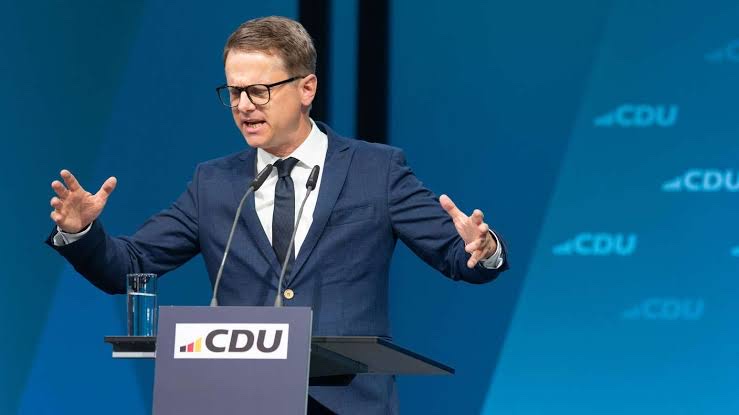
Carsten Linnemann speaking at a CDU lectern in front of a blue CDU backdrop
Carsten Linnemann speaking at a CDU lectern.

How to read this page

Two tracks: what the numbers show, and what he argues

German economic debate since 2023 has turned on one question: was weak growth a passing problem caused by energy prices and interest rates, or a sign of deeper structural problems? The answer affects every policy covered on this site, from tax and social contributions to health financing.

Carsten Linnemann’s answer has long been structural. As chair of the Mittelstands- und Wirtschaftsunion (MIT) from 2013 to 2021, as chair of the CDU programme commission from 2022 and as Secretary-General from July 2023 to July 2026, he argued that Germany needs faster administration, lower taxes and levies on work, cheaper energy and a welfare state that pushes harder towards employment.

Those are political positions, not findings. Below, each section first sets out the economic analysis from official statistics, then the documented position and the main objections to it.

An economist’s programme reads the state through its costs: of labour, of energy, of delay.

Editorial noteSince 29 July 2026 Linnemann has been Federal Minister of Health. Economic policy is the responsibility of the Federal Ministry for Economic Affairs and Energy and the Federal Ministry of Finance. His economic positions are documented here because they shape how he approaches health and social insurance.

02 / Economic analysis

The macroeconomic picture in five numbers

Official statistics only. Projections are labelled as such and will be superseded.

+0.2%Real GDP growth after two years of contraction (2024 revised: −0.5%)2025 · Destatis, press release 017/2026
€4,529.7bnNominal gross domestic product (+3.3% in current prices)2025 · Destatis national accounts table, status Aug 2026
2.4%General government deficit as a share of GDP (€107.4bn; 2024: 2.7%)2025 · Destatis, press release 017/2026
+0.3%GDP growth on the previous quarter, price, seasonally and calendar adjusted (+1.0% on a year earlier)Q2 2026 · Destatis, press release 303/2026

Real GDP growth, outturn and federal projection

Unit: % change on previous year, price-adjusted · 2024–2027 · bar length = size of change

  • 2024 (revised)−0.5%
  • 2025+0.2%
  • 2026 (projection)+0.5%
  • 2027 (projection)+0.9%

SourceDestatis, press release 017/2026 (15 Jan 2026); Federal Government, Frühjahrsprojektion 2026 (22 Apr 2026). Turquoise = contraction; citrus = projection.

What drove 2025

Destatis reports that growth in 2025 came from consumption: private consumption rose by 1.4% and government consumption by 1.5% in real terms. The weak spots were on the supply side. Value added in manufacturing fell by 1.3%, investment in machinery and equipment by 2.3% and construction investment by 0.9%; exports fell slightly (−0.3%) while imports rose by 3.6%. Labour productivity per hour worked grew by only 0.4%.

What the projection says

In its spring projection of 22 April 2026, the federal government expected growth of 0.5% for 2026 and 0.9% for 2027, with inflation of 2.7% and 2.8%. It cited energy and raw-material price increases linked to the conflict in the Middle East, tariffs and protectionism as headwinds, and infrastructure and defence spending as support. The government’s autumn projection is due on 8 October 2026; this page will use it once the official release is available.

What should not be exaggerated

Germany is not in fiscal crisis: a deficit of 2.4% of GDP is below the 3% EU reference value. Employment averaged 46.0 million in 2025, close to its historical high, and the ILO unemployment rate stood at 4.3% in August 2026. The problem economists describe is low trend growth, not collapse.

03 / Positions

Eight policy fields: analysis, position, objection

Each block keeps the evidence and the political position apart. Status labels describe where the position stands as of October 2026.

  • Political position
  • In force
  • Proposed
  • Open question

01

Competitiveness and energy

Partly in force

Economic analysis

Manufacturing value added fell by 1.3% in 2025. The federal government names energy costs, taxes and levies and bureaucracy as structural causes of weak growth.

Political position

The CDU’s Agenda 2030 promised at least 5 cents per kWh lower electricity prices through cuts to electricity tax and grid charges.

Objection

Subsidising grid charges from the federal budget shifts costs to taxpayers rather than lowering system costs.

Current status

Since 1 January 2026 the electricity-tax relief for manufacturing, agriculture and forestry has been set permanently at the EU minimum, and a federal grant of about €6.5bn lowers transmission grid charges in 2026. A general cut for all consumers has not followed. See growth and competitiveness.

02

Bureaucracy reduction

Political position

Economic analysis

The National Regulatory Control Council (NKR) puts the cost of information obligations for business at €64bn a year. In 2024/25 the annual compliance burden fell by about €3.2bn.

Political position

Faster approvals for transport, construction, digital and industrial projects (Agenda 2030); fewer reporting duties and risk-based checks.

Objection

Many rules protect workers, consumers and the environment; cutting them can move costs rather than remove them.

Current status

The cabinet’s modernisation agenda (October 2025) targets a 25% cut in bureaucracy costs. In health he has announced a Bürokratierückbaugesetz. Full analysis: bureaucracy reduction.

03

Labour incentives

Partly in force

Economic analysis

Total hours worked fell by 0.2% in 2025 to 61.26bn while the part-time rate reached a record 39.9% (IAB).

Political position

“Leistung muss sich lohnen”: tax-free overtime supplements, a weekly instead of daily maximum working time, the Aktivrente, and a stricter basic-income system.

Objection

Unions and opposition parties argue that the eight-hour day protects health, and that benefit sanctions affect people who cannot work.

Current status

The Aktivrente applies from 1 January 2026; the Neue Grundsicherung was passed on 5 March 2026. A working-time bill was in draft in June 2026. See work and performance.

04

Investment and tax

In force

Economic analysis

Investment in machinery and equipment fell by 2.3% in 2025, following earlier declines.

Political position

Agenda 2030: corporate income tax cut gradually to 10%, simpler trade tax, better depreciation.

Objection

Tax cuts without matching savings widen deficits; the ZEW estimated the Union’s 2025 tax plans at about €47bn a year in lost revenue.

Current status

The investment programme passed by the Bundesrat on 11 July 2025 introduced 30% declining-balance depreciation (July 2025 – end 2027) and cuts corporate income tax from 15% to 10% in five steps from 2028 to 2032.

05

Infrastructure

In implementation

Economic analysis

Public investment backlogs in transport, schools and digital networks are widely documented; a lasting increase in public capital raises potential output if projects are delivered.

Political position

The CDU campaigned on keeping the debt brake; after the election the coalition parties backed a constitutional amendment for a credit-financed special fund.

Objection

Critics from different sides question whether the money is genuinely additional, and whether planning capacity can absorb it.

Current status

The Sondervermögen Infrastruktur und Klimaneutralität allows up to €500bn of borrowing over twelve years (Article 143h Basic Law), including €100bn for the Länder and €100bn for the Climate and Transformation Fund.

06

Innovation and digitalisation

Target

Economic analysis

Productivity growth is the main long-run source of income growth, and it has been weak (+0.4% per hour in 2025).

Political position

Agenda 2030 set a target of 3.5% of GDP for research and development by 2030, and a digital federal agency for skilled-worker immigration.

Objection

R&D targets measure inputs, not results; most R&D is financed by business, so the state controls only part of the ratio.

Current status

As health minister he has committed to completing two inherited bills, the digital-health law GeDIG and the medical registries law (Health Committee, 23 September 2026). See digital health.

07

Mittelstand and entrepreneurship

Political position

Economic analysis

More than 3.5 million SMEs employ just under 22 million people, over half of all employees (IfM Bonn, reference year 2024).

Political position

The Mittelstand as the backbone of the social market economy; fewer reporting duties, simpler taxes, easier succession.

Objection

Size-based exemptions can create thresholds that discourage firms from growing.

Current status

Detailed on the Mittelstand page; his association role on the MIT page.

08

Social contributions

Open question

Economic analysis

Combined social contribution rates averaged about 42.3% of gross wages in 2026, shared between employer and employee.

Political position

Agenda 2030 aimed to bring contributions back towards 40%. As health minister he has said he wants contribution rates eventually to fall.

Objection

Lower contributions require either benefit cuts, more tax financing or faster wage growth; each has losers.

Current status

See tax and social policy and pension policy.

04 / Political position

Agenda 2030: the CDU’s economic programme of January 2025

Adopted by the CDU federal executive at its meeting in Hamburg on 10–11 January 2025, six weeks before the federal election. Linnemann, as Secretary-General, presented it as relief above all for the middle of society.

Selected Agenda 2030 proposals and what happened to them by October 2026
Proposal (CDU position)OutcomeStatus
Growth of at least 2% a year2025: +0.2%; federal spring projection 2026: +0.5%Not reached
Income tax reform in four steps from 2026; top rate only from €80,000In 2026 the 42% rate still starts at €69,879 taxable income (single)Open
Abolish the solidarity surcharge completelyNot part of the legislation reviewed for this pageOpen
Corporate income tax gradually down to 10%Legislated: 15% → 10% from 2028 to 2032In force
Better depreciation30% declining-balance depreciation, July 2025 – Dec 2027In force
€2,000 a month tax-free for people working past retirement ageAktivrente, from 1 Jan 2026In force
Tax-free overtime supplements for full-time workIncluded in the 2025 coalition agreement; draft legislation preparedProposed
Weekly instead of daily maximum working timeDraft amendment to the Working Time Act circulated June 2026Proposed
Replace Bürgergeld with a new basic incomeNeue Grundsicherung passed 5 Mar 2026In force
Electricity at least 5 ct/kWh cheaperElectricity-tax relief for manufacturing; grid-charge subsidy 2026Partly
R&D spending of 3.5% of GDP by 2030TargetPosition

Sources: Schwäbische Zeitung/dpa and ZDF on the Agenda 2030 (Jan 2025); Federal Ministry of Finance on the investment programme; Bundestag on the Aktivrente, Neue Grundsicherung and electricity tax. Tax thresholds: 2026 income tax tariff.

The logic

The Agenda 2030 combined supply-side tax cuts with labour-market measures and lower energy costs. It was to be financed without tax increases, through growth, savings on the basic-income system and a stricter migration policy, according to press summaries of the resolution.

The objection

Economists questioned the funding. The ZEW Mannheim estimated in its analysis of the 2025 election programmes that the Union’s tax plans would reduce revenue by about €47bn a year: around €35bn from flattening the income-tax tariff and about €20bn initially from lower corporate tax, better depreciation and loss offsetting. The ZEW put the FDP and AfD plans considerably higher.

The result

In coalition with the SPD, the business-tax elements were legislated first; the income-tax and solidarity-surcharge elements remain open. Linnemann did not take a cabinet post in 2025 and stayed Secretary-General until July 2026, so his role in implementation was through the party and, from May 2025, as deputy chair of the CDU/CSU parliamentary group for labour and social affairs.

05 / Political position

The 2024 party programme

“In Freiheit leben. Deutschland sicher in die Zukunft führen” — adopted on 7 May 2024 at the 36th Federal Party Congress in Berlin. Linnemann chaired the programme commission.

The CDU’s fourth basic programme replaced the 2007 text. It is organised around five chapters: a country that is free and secure; a society that holds together and opens up opportunities; an economy that creates prosperity for all; a Germany that is sustainable and sovereign; and a state that works and leads the way.

The economic chapter restates the party’s commitment to the social market economy, with performance, private property and competition on one side and social partnership and protection against life’s risks on the other. The chapter on the state links economic weakness with administrative slowness, a theme that runs through Linnemann’s books and speeches. The Konrad Adenauer Foundation summarises the programme’s core as a Christian view of humanity that balances freedom and security; Linnemann has described it as putting the individual, not the collective, at the centre.

A basic programme sets principles, not legislation. Its practical translation was the Agenda 2030 above and, after the election, the coalition agreement “Verantwortung für Deutschland” of 5 May 2025, which was negotiated with the SPD and contains compromises on most of these points. More on his party role: CDU Secretary-General.

06 / Competing arguments

Is the supply-side diagnosis right?

The central dispute is about cause. Both sides cite real data.

Structural reading (CDU, business associations)

  • Manufacturing value added and equipment investment fell in 2025 even as consumption grew, which points to supply-side problems.
  • The federal economics minister herself names energy costs, the tax and contribution burden, and bureaucracy as structural causes.
  • Germany’s tax and contribution burden on labour is the second highest in the OECD (Taxing Wages 2026).
  • A shrinking working-age population makes higher participation and productivity unavoidable.

Demand and investment reading (unions, parts of the SPD and Greens, some economists)

  • Years of low public investment, not regulation, explain much of the weakness; the €500bn fund is a belated correction.
  • External shocks — energy prices, tariffs, Chinese competition in industrial goods — would hurt any industrial exporter.
  • Tax cuts benefit higher incomes most and reduce the state’s ability to invest.
  • Labour-market tightening through sanctions does little when unemployment is concentrated among people with health problems or no qualifications.

Most forecasters now treat both as relevant: the federal projections explicitly rely on public investment for the near-term recovery while naming structural reforms as the condition for lasting growth.

07 / Link to the health ministry

Why an economist’s programme matters for health

Statutory health insurance and long-term care insurance are financed mainly by contributions on wages. That makes contribution rates a labour-cost issue, and labour costs are where Linnemann’s economic thinking starts. In his first Bundestag speech as minister on 10 September 2026 he made sound financing his second guiding principle and argued that employees and employers must not be burdened with ever-higher non-wage labour costs.

The same speech tied the bureaucracy theme to health: doctors and nurses, he said, should spend their time on patients rather than forms. Whether the tools of economic policy — cost control, incentives, deregulation — fit a sector built on need and solidarity is one of the main criticisms of his appointment. Both sides are set out on health policy and criticism and controversies.

„… wir dürfen die Arbeitnehmer und Arbeitgeber nicht mit immer höheren Lohnnebenkosten belasten.“

Carsten Linnemann · 10 September 2026 · Bundestag budget debate on the 2027 health budget · English: “We must not burden employees and employers with ever-higher non-wage labour costs.” · Bundesregierung

„Wir müssen jetzt einfach machen.“

Carsten Linnemann · 15 May 2025 · Bundestag debate on labour-market and social policy · English: “We now simply have to get on with it.” · Deutscher Bundestag