Health ministry · Since 29 July 2026
The new health minister
On 29 July 2026 Federal President Frank-Walter Steinmeier appointed Carsten Linnemann Federal Minister of Health. After three years running the CDU’s party headquarters, he now heads a ministry with a budget in the tens of billions, a statutory insurance system spending more than €350 billion a year, and a long-term care insurance he himself calls financially “disastrous”.
- Announced
- 24 July 2026, by Chancellor Friedrich Merz
- Appointed
- 29 July 2026, by Federal President Steinmeier
- Sworn in
- 8 September 2026, before the Bundestag
- Predecessor
- Nina Warken (now Head of the Federal Chancellery)
How the July 2026 reshuffle happened
A change at the top of the CDU/CSU parliamentary group set off a chain of moves that ended with the CDU’s Secretary-General in the health ministry.
- Mid-Jul 2026
Group chair resigns
Jens Spahn stepped down as chair of the CDU/CSU parliamentary group. ZDF reported the controversy over his use of surrogacy in the United States, and how late it became known, as the cause.
- 22 Jul 2026
Frei proposed for the group
Friedrich Merz and Markus Söder proposed Thorsten Frei, until then Head of the Federal Chancellery, as the new group chair. That left the Chancellery post open.
- 24 Jul 2026
Merz announces the changes
Health Minister Nina Warken moved to the Chancellery as its head and Federal Minister for Special Tasks, the first woman in that role. Carsten Linnemann was named as her successor. Philipp Amthor became Minister of State for federal–Länder relations. Merz called the health ministry “a central department of my government’s reform efforts” and said it needed a minister who was both steadfast and willing to reform.
- 27 Jul 2026
New Secretary-General
On Merz’s proposal, the CDU federal executive unanimously elected Franziska Hoppermann as Linnemann’s successor at party headquarters. That ended his term as CDU Secretary-General (July 2023 – July 2026).
- 29 Jul 2026
Appointment and handover
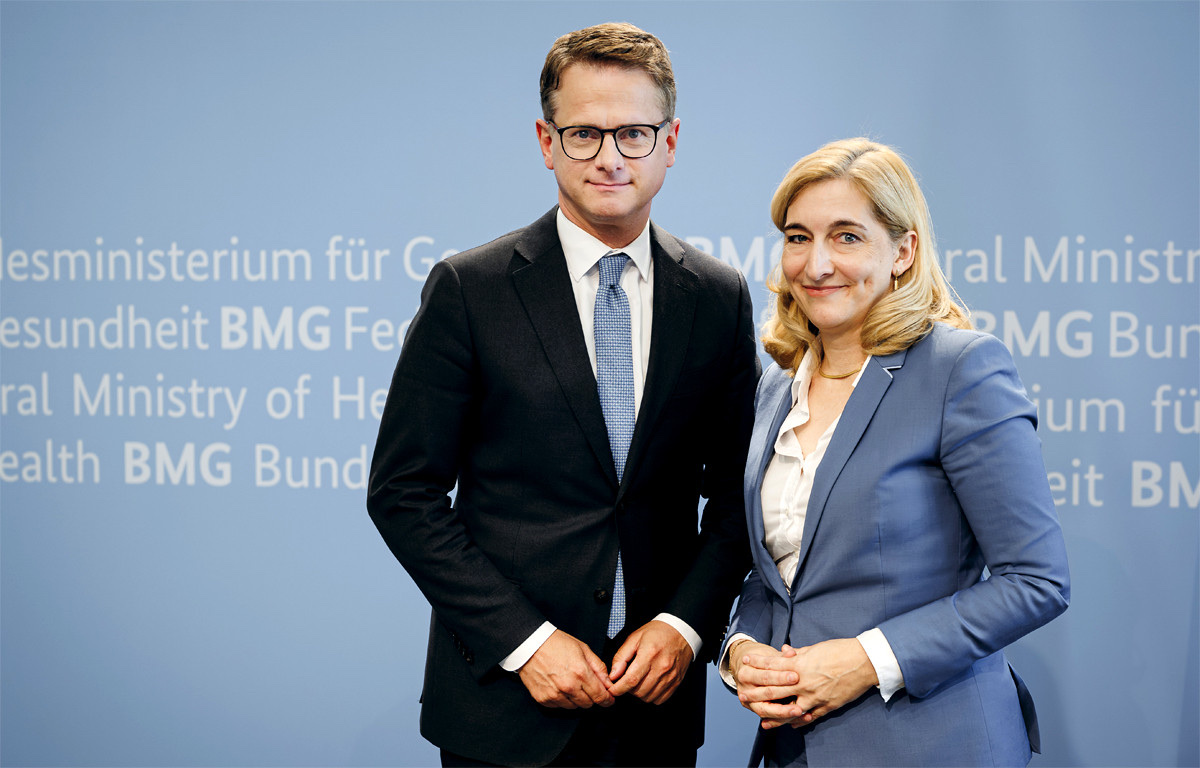
Federal President Steinmeier formally appointed the new ministers. At the ministry handover the same day, Linnemann said his political mandate was to make health and long-term care dependable and affordable, and that he took up the post with humility. He named Dr. Georg Kippels and Dr. Christiane Schenderlein as Parliamentary State Secretaries.
- 8 Sep 2026
Oath of office
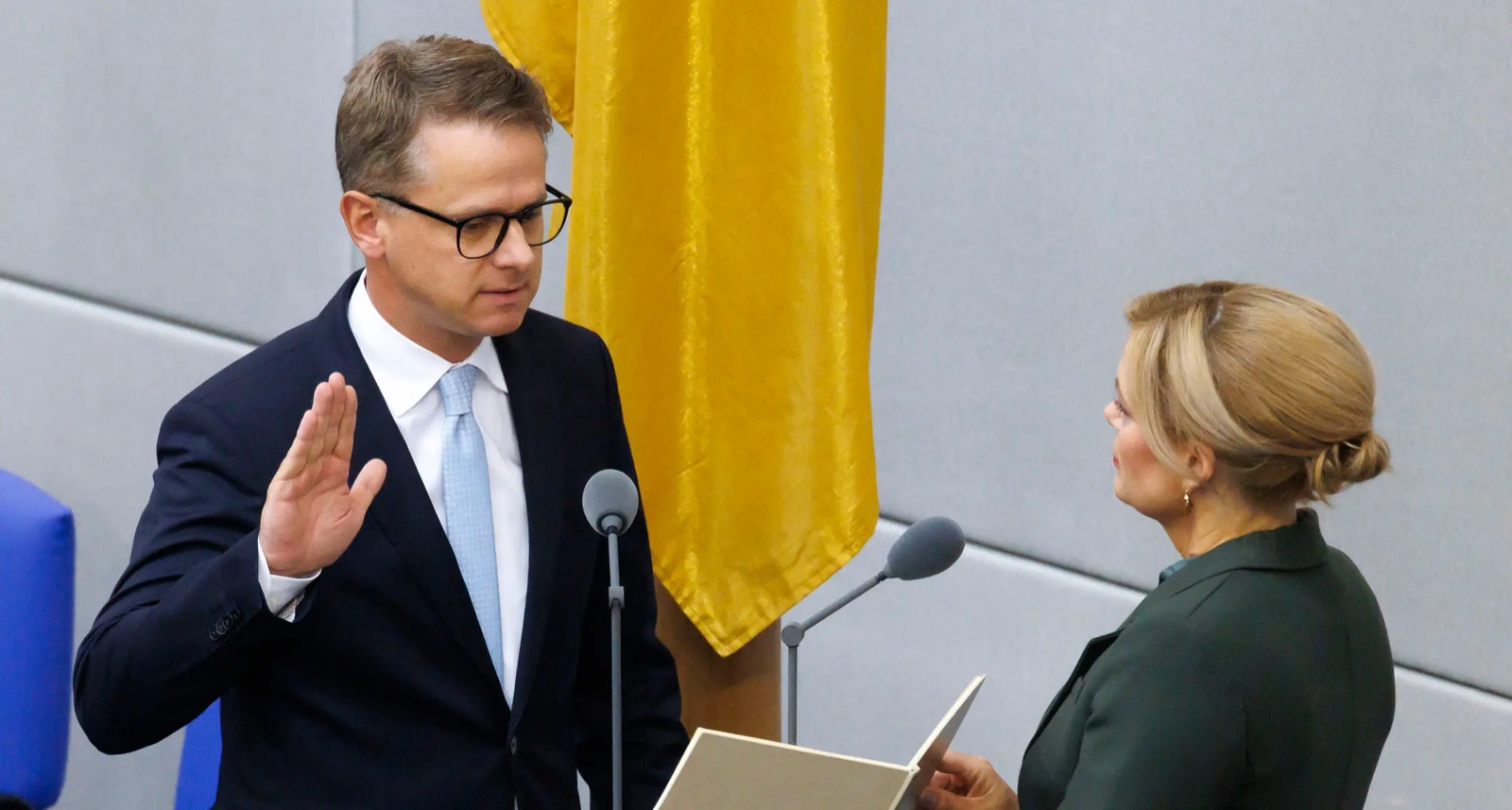
In the first sitting week after the summer recess, Bundestag President Julia Klöckner administered the oath of office to Linnemann (10:07) and to the new Transport Minister Steffen Bilger (10:06).
Verification noteLinnemann’s and Warken’s remarks at the handover are paraphrased from the ministry’s English-language report. The German original was not available to us when we checked, so they are not given in quotation marks.
From party headquarters to a federal ministry
The move from party leadership to running a federal ministry, and why it was questioned.
As CDU Secretary-General, Linnemann ran the party organisation, chaired the commission behind the 2024 party programme and led the 2025 federal election campaign. From May 2025 he was also deputy chair of the CDU/CSU parliamentary group, covering labour and social affairs. He sat on the CDU side in the 2025 coalition talks. When Merz announced the appointment, he said Linnemann had already dealt with health in those talks.
A ministry is a different kind of job. The Federal Ministry of Health (Bundesministerium für Gesundheit, BMG) drafts legislation, oversees federal agencies such as the BfArM, the Paul-Ehrlich-Institut and the Robert Koch Institute, and defends its budget before parliament. Much of the health system is run not by the ministry but by the self-administration and by the Länder. A minister sets the legal framework. He does not run hospitals or insurers.
Linnemann had turned down a cabinet post once already. On 15 April 2025 he announced that he would stay on as Secretary-General because rebuilding the CDU “was not yet complete”. In a Phoenix interview the same spring he said that, had he become health minister, he would probably not have been successful. The Pharmazeutische Zeitung reported his remark in that context that a cobbler should stick to his last. When his appointment was announced in July 2026, several outlets set those remarks against it.
He addressed this directly. In an Instagram video posted on 24 July 2026, as reported by apotheke adhoc, he asked for patience and spoke of his great respect for the job. In a Bild interview the next day he said that circumstances had changed since May 2025. Back then, he explained, he had put the welfare-benefit reform and his party role first.
„Klar, ich bin auch ehrlich, ihr müsst mir ein bisschen Zeit geben.“
„Ich habe auch echt einen Höllenrespekt vor dieser Aufgabe.“
Welcome, scepticism and opposition
Reactions on the day of the announcement, as reported by kma-online, Ärzteblatt and ZDF.
Medical profession: a chance
Klaus Reinhardt, President of the German Medical Association (Bundesärztekammer), told the Deutsches Ärzteblatt that he saw a chance to set necessary directions.
Nursing: no continuity
Christine Vogler, President of the German Nursing Council (Deutscher Pflegerat), said on ZDF that the change did not signal policy continuity. Coming months after the previous minister had started several nursing reforms, this was a pointed observation.
Greens: expertise questioned
Janosch Dahmen, the Greens’ health spokesperson, asked whether health-policy experience, ministerial leadership or medical expertise no longer mattered for the post. He argued that the role needed expertise and empathy rather than slogans, and that trust in health policy was already under strain.
Left: a “social-policy hardliner”
Ates Gürpinar (Die Linke) called Linnemann a social-policy hardliner. He said it was not a good sign when someone became minister who had so far stood out by punching down, a reference to Linnemann’s role in the debate over welfare benefits. That debate is documented on the criticism page.
ContextSupporters point to the same profile critics object to. As an economist who has worked on social insurance financing, labour costs and the reform of basic income support, he comes to a ministry whose biggest problem is the financing of statutory health and long-term care insurance. How these judgements look will depend on results, not on the CV.
Three guiding principles: 10 September 2026
His first Bundestag speech as minister came in the debate on the 2027 health budget. He set out three guiding principles for his decisions.
„Wer medizinische Hilfe braucht, muss schnell an die richtige Stelle kommen.“
„… denn wir dürfen die Arbeitnehmer und Arbeitgeber nicht mit immer höheren Lohnnebenkosten belasten.“
„Ärzte und Pflegekräfte sollen Zeit für ihre Patienten haben und nicht für Formulare verwenden.“
In the same speech he said that, in his view, contributions should fall in the longer term. He described the finances of social long-term care insurance as disastrous (desaströs), with an expected deficit of €8 billion in 2027 and more than €15 billion in 2028. He closed with a one-line summary: „Besser steuern, solide finanzieren, mehr Zeit für die Menschen: Das ist der Auftrag.“ In English: “Steer better, finance soundly, more time for people: that is the mandate.”
Source for all quotations in this section: speech of 10 September 2026, published by the Federal Government (bundesregierung.de), checked against the text on 8 October 2026; see also Ärzteblatt, 11 Sep 2026.
Eleven files on the minister’s desk
Each file is labelled with its status as of 8 October 2026. Anything decided before 29 July 2026 is marked as inherited from Nina Warken’s time in office.
- Inherited
- Under review
- Proposed
- In implementation
- In force
- Open question
- Political position
Statutory health insurance (GKV): contribution stabilisation
The GKV-Beitragssatzstabilisierungsgesetz passed the Bundestag on 10 July 2026 by 319 votes to 286 and was approved by the Bundesrat. It is designed to provide about €19 billion of relief in 2027. Measures include a higher statutory manufacturer discount on medicines (15.5%), federal payments for recipients of basic income support rising from €1 billion in 2027 to €2.75 billion a year from 2031, a cost brake for hospitals for 2027–2029 and the removal of homeopathy from the benefits catalogue.
Proposed Linnemann has announced a follow-up savings law, which the trade press calls “Spargesetz 2”. It is meant to pay for commitments made since July, including about €450 million for hospitals and €100 million for university clinics as reported, plus improvements in psychotherapy, without raising contribution rates in 2027. Proposed He also wants insurers to be required again to tell each member individually when their contribution rises (20 September 2026). More on GKV.
Financing: the 2027 contribution rate
The average additional contribution for 2027 has not yet been set. The GKV estimators’ group (Schätzerkreis) meets on 15 October 2026, and the ministry then publishes the official average by 1 November. The official average for 2026 is 2.9%, but on 1 January 2026 the funds actually charged 3.13% on average (BMG). The 2027 draft federal budget cuts the BMG budget from €21.77 billion to €14.33 billion. In his FAZ interview of September 2026 he said he wanted contribution rates eventually to fall. Full financing analysis.
Hospitals
The hospital reform (KHVVG) came into force on 1 January 2025. The amending act (KHAG) followed on 15 April 2026 and pushed the new standby payments (Vorhaltevergütung) back to 2028. A transformation fund of up to €50 billion for 2026–2035 is In implementation: the first approval came in April 2026. At the ministry’s hospital summit on 22 September 2026, Linnemann announced that a planned bureaucracy-reduction law would cut duplicate inspections and introduce risk-based checks. Hospital reform in detail.
Emergency care reform
The cabinet adopted the bill on 22 April 2026, and its first reading in the Bundestag was on 9 July 2026. As of early October the final Bundestag vote had not taken place. At the hospital summit Linnemann announced that he wanted it passed this year.
Long-term care (nursing)
On 30 September 2026 the cabinet adopted the Pflegeneuordnungsgesetz (PNOG), which now goes to parliament. The general contribution rate stays at 3.6%. The surcharge for childless members rises from 0.6% to 0.9% from 2027. Benefits are to be indexed annually to core inflation from 2029. Pension credits for family carers are kept. Under review An expert commission on structural reform starts work in October 2026. In his September FAZ interview he warned that without fundamental reform the system would collapse in the 2030s. Nursing and long-term care.
Workforce and primary care
A primary-care system based on the 2025 coalition agreement would give patients a first point of contact who decides on specialist referral, supported by digital initial assessment through the 116 117 service. Linnemann told the Bundestag on 23 September 2026 that a draft would come “probably in November”. The Ärzteblatt reports that implementation is to start in 2028. At the same time, 23.4% of practising physicians were aged 60 or over at the end of 2025 (German Medical Association). The medical workforce.
Digital health
The digital-health bill GeDIG (Inherited, cabinet 15 July 2026) had its first Bundestag reading on 8 October 2026; in his budget speech he flagged it for debate in October. It builds on infrastructure already In force: the electronic patient record for all (about 73 million records created by April 2026, gematik) and the mandatory e-prescription (since 1 January 2024). Digital health.
Medical data: Medizinregistergesetz
The medical registries bill, intended to make quality-assured registry data usable for care and research and to create a coordinating centre at BfArM, was adopted by the cabinet on 11 March 2026 under Nina Warken and is in parliamentary procedure (BMG, 11 Mar 2026). In the Health Committee on 23 September 2026 Linnemann listed it among the bills he intends to see through (hib 733/2026). Its companion, the digital bill GeDIG, was adopted by the cabinet on 15 July 2026 and had its first Bundestag reading on 8 October 2026. It would add to the Health Data Use Act (GDNG, In force since 26 March 2024) and the EU’s European Health Data Space regulation, which applies in stages from March 2027. Health data.
Health security: Gesundheitssicherstellungsgesetz
Also announced in the Health Committee: a law to make sure health care keeps working in a crisis. Its content has not been published. Related federal tools are the medicine-shortage law ALBVVG (In force since 27 July 2023) and BfArM’s shortage reporting, which recorded 1,514 reports covering 1,041 shortages in 2025 (Zi analysis of BfArM data). Health security.
Pharmaceuticals and pharmacies
The pharmacy reform (ApoVWG) passed the Bundestag on 22 May and the Bundesrat on 12 June 2026, before he took office. At the German Pharmacists’ Day in Munich (15–17 September 2026) he attacked co-payment waivers offered by foreign mail-order pharmacies. In his words, „Entweder dürfen es beide oder keiner“ (“either both may do it, or neither”). Germany has since asked the EU to examine the competitive disadvantage. GKV drug spending reached €58.3 billion in 2025 (vdek, BMG data). Pharmaceutical policy.
Prevention
In the government question time on 23 September 2026 he said: „Die beste Gesundheitspolitik lässt Krankheiten gar nicht erst entstehen.“ In English: “The best health policy stops illnesses from arising in the first place.” No specific prevention bill has been announced so far. Prevention.
Demographic change
One in five people in Germany was 67 or older in 2024. Destatis projects one in four by 2035 (16th coordinated population projection). Two expert bodies are working on the structural consequences. The care commission must report by March 2027 at the latest (hib), although other reports give January 2027. A Finance Commission for health insurance is to present more structural proposals in December 2026. Demographic change.
06 / In parliament
First weeks before the Bundestag
His first appearances as minister were mostly in parliament. On 8 September he took the oath of office. On 10 September he defended the 2027 health budget. On 23 September he answered questions from MPs in the plenary government question time (Regierungsbefragung) and then appeared before the Health Committee.
The committee session set out his aims most fully. He said he wanted the best-performing health system in the world (the Bundestag press service, hib 733/2026, summarises the aim as das leistungsfähigste Gesundheitssystem der Welt), through prevention, digitalisation, better patient steering, stable contributions and solidarity. He also announced the care commission, changes to the GKV savings law ahead of the estimators’ meeting, and the registry, digital and health-security laws.
In the plenary he rejected abolishing private health insurance (PKV). He cited constitutional concerns and argued that the dual system keeps the system open to innovation. He also promised there would be no cuts to the pension entitlements of family carers.
Efficiency first: what the first ten weeks suggest
An analysis of his documented statements. These are his positions, not settled facts.
So far his approach to health policy follows the line he took as an economist and party strategist: health insurance is financed from wages, so its costs are a labour-market issue. His first and most quoted interview as minister, with the Frankfurter Allgemeine Zeitung in September 2026, opened with the claim that Germany has a strong system that must become more efficient.
Three features stand out. First, he gives steering priority over spending. The primary-care model, the emergency-care reform and the pharmacy’s role in guiding patients are all about getting patients to the right place, not about paying for more capacity. Second, contribution stability is his test of every measure, which explains the “Spargesetz 2” announcement soon after he took office. Third, he links reducing bureaucracy to professional time: inspections, documentation and forms appear in almost every speech.
Critics answer from several directions. Opposition parties warn that a cost-first approach could mean benefit cuts dressed up as efficiency. Nursing organisations say that higher contributions for the childless and annual indexation do not solve structural underfunding. Hospital operators point out that the Krankenhaus Rating Report 2026 expects 60% of hospitals to make losses in 2027 under the stabilisation-law scenario. Each of these points is examined on the health policy and criticism pages.
He has also made a point of political courage. In the FAZ interview he said: „Wenn wir immer auf die Wahlen schauen, bekommen wir Reformen nie hin.“ In English: “If we always look at the elections, we will never get reforms done.” The next tests come soon: the estimators’ meeting on 15 October, the parliamentary debate on the care bill, and the promised primary-care draft.
„Wir haben ein starkes Gesundheitssystem, das effizienter werden muss, damit die Menschen besser und zielgenauer versorgt werden.“
Sources & further reading
- Federal Government — Merz announces cabinet changes (24 Jul 2026)
- kma-online — Linnemann wird neuer Bundesgesundheitsminister (reactions) (24 Jul 2026)
- Federal Ministry of Health — Handover ceremony (29 Jul 2026)
- Deutsches Ärzteblatt — Linnemann appointed Federal Minister of Health (29 Jul 2026)
- ZDF — Hoppermann elected CDU Secretary-General (27 Jul 2026)
- Pharmazeutische Zeitung — Earlier remarks on the health ministry (24 Jul 2026)
- apotheke adhoc — „Ihr müsst mir ein bisschen Zeit geben“ (Jul 2026)
- German Bundestag — Swearing-in of Bilger and Linnemann (8 Sep 2026)
- Federal Government — Speech on the 2027 health budget (10 Sep 2026)
- Federal Ministry of Health — FAZ interview (Sep 2026)
- Federal Ministry of Health — Government question time (23 Sep 2026)
- German Bundestag, hib 733/2026 — Minister in the Health Committee (23 Sep 2026)
- Federal Ministry of Health — Speech at the hospital summit (22 Sep 2026)
- Federal Ministry of Health — Bundestag passes GKV-Beitragssatzstabilisierungsgesetz (10 Jul 2026)
- Federal Ministry of Health — Cabinet adopts Pflegeneuordnungsgesetz (30 Sep 2026)
- apotheke adhoc — Linnemann plans “Spargesetz 2” (Sep 2026)
- Ärzte Zeitung — Primary-care draft announced for November (24 Sep 2026)
- Deutsche Apotheker Zeitung — Pharmacists’ Day 2026 (20 Sep 2026)