Party · Christian Democratic Union
CDU leadership: sixteen years in the party’s governing bodies
From the North Rhine-Westphalian state executive in 2010 to the general secretariat in Berlin, Carsten Linnemann climbed through every tier of the CDU’s leadership — and chaired the commission that wrote the party’s fourth basic programme.
Party offices, in order
Where official sources disagree on dates, both versions are shown.
- 1994 · 1998
Junge Union, then CDU
Joins the party’s youth organisation in 1994 and the CDU in 1998; chairs the Junge Union’s Egge district branch 1997–2001 (Konrad Adenauer Foundation, single source).
- 2004–2008
Municipal council, Altenbeken
His first elected office. See local politics.
- since 2010
State executive, CDU North Rhine-Westphalia
Member of the Landesvorstand of the CDU’s largest state association (Bundestag biography; Federal Government CV).
- from 2013
Federal executive
Member of the CDU Bundesvorstand. The Bundestag biography gives “2013 to 2021”; the Federal Government CV says “since 2013”. As Secretary-General he belonged to the party’s leadership ex officio.
- 2013–2021
Federal Chair of the MIT
Leads the party’s business and small-enterprise association. See MIT.
- from 2022
Deputy party chair
One of the deputy chairs of the federal CDU under Friedrich Merz. The Bundestag biography gives 2022–2023; the Federal Government CV gives 2022–2024.
- from 2022
Chair of the programme commission
Leads the drafting of a new basic programme, adopted in May 2024.
- Jul 2023 – Jul 2026
Secretary-General
Appointed by Merz in July 2023 (the Konrad Adenauer Foundation gives 12 July 2023) and confirmed by the 36th party congress in May 2024 with 91.37% of delegates’ votes (KAS). Succeeded by Franziska Hoppermann on 27 July 2026.
- since 29 Jul 2026
Federal Minister of Health
Leaves party office for government. See Federal Minister of Health.
- Party member since
- 1998 (KAS)
- State executive NRW
- since 2010
- Federal executive
- from 2013
- Deputy party chair
- from 2022
- Programme commission
- Chair from 2022
- Secretary-General
- Jul 2023 – Jul 2026
Source conflictsThe end dates of his federal-executive membership and of his deputy chairmanship differ between the Bundestag biography and the Federal Government CV. This page reports both and does not choose between them.
How the CDU is led
A short guide to the bodies in which Linnemann has sat, from the bottom up.
- Local and district associationsMembers organise in local and district (Kreis) associations, which nominate candidates for constituencies such as Paderborn.
- State associationsEach Land has its own CDU (Bavaria has the separate CSU). Linnemann has sat on the NRW state executive since 2010.
- Federal party congressThe highest body: elects the chair, deputies and Secretary-General, adopts the basic programme.
- Federal executiveLeads the party between congresses; includes the presidium and elected members.
- Presidium and Secretary-GeneralThe inner leadership; the Secretary-General runs the federal party headquarters, the Konrad-Adenauer-Haus.
Associations
Alongside the territorial structure, the CDU has associations (Vereinigungen) for particular groups — the Junge Union, the MIT, the employee wing CDA, the Frauen Union and others. Linnemann rose through two of them: the Junge Union in the 1990s and the MIT from 2013.
The programme commission
A basic programme (Grundsatzprogramm) sets out the party’s values and long-term aims. It is drafted by a commission appointed by the federal executive, debated across the membership and adopted by a party congress. The 2024 programme was only the fourth in the CDU’s history.
The Secretary-General
Proposed by the chair and elected by the party congress, the Secretary-General manages the party organisation, leads election campaigns and is the party’s chief communicator. See Secretary-General 2023–2026.
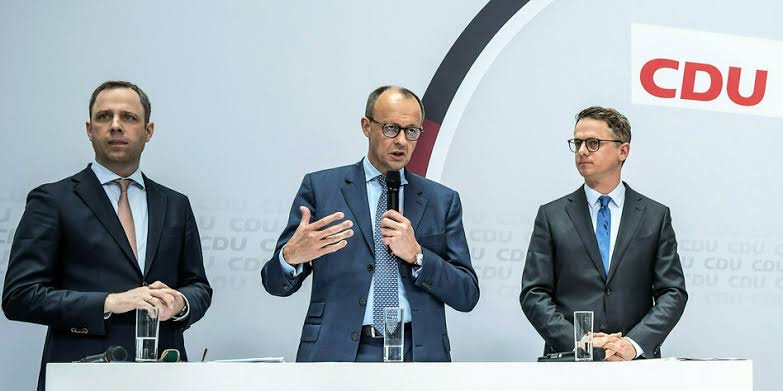
From programme to platform
Two documents show most clearly how Linnemann shaped the CDU’s policy after 2022.
“In Freiheit leben” — the basic programme of 2024
After the CDU’s defeat in the 2021 federal election and the end of the Merkel era, the new chair Friedrich Merz made a programmatic renewal one of his priorities. Linnemann, as chair of the programme commission from 2022, led the process. The result, In Freiheit leben. Deutschland sicher in die Zukunft führen, was adopted on 7 May 2024 at the 36th Federal Party Congress in Berlin (6–8 May 2024).
According to the Konrad Adenauer Foundation’s summary, Linnemann described the programme’s guiding idea as putting the individual, rather than the collective, at the centre. Its themes — freedom and responsibility, security, a performance-oriented social market economy and a strong state in its core tasks — gave the party an agreed framework for the following election campaign. Critics inside and outside the party argued about particular passages, especially on migration and national identity.
“Agenda 2030” — the economic platform of 2025
At its meeting in Hamburg on 10–11 January 2025, the CDU federal executive adopted the “Agenda 2030”, an economic programme for the snap election campaign. As reported by dpa, it set a target of at least 2% growth and proposed a four-step income-tax reform from 2026 with the top rate starting at €80,000, a weekly instead of a daily maximum working time, and electricity prices at least 5 cents per kilowatt-hour lower. Linnemann described relief for the middle class as its core. Economists and opponents questioned how the tax relief would be financed.
The books behind the programme work
Three books published by Herder trace the arguments he brought into the party leadership.
| Year | Title | Theme |
|---|---|---|
| 2017 | Die machen eh, was sie wollen. Wut, Frust, Unbehagen – Politik muss besser werden | Voter frustration with politics and the case for clearer, more accountable decision-making |
| 2019 | Der politische Islam gehört nicht zu Deutschland (co-edited with Winfried Bausback) | Defence of a liberal society against political Islam; criticised by some reviewers for right-populist tones |
| 2022 | Die ticken doch nicht richtig! Warum Politik neu denken muss | A call for a different style of politics, published as he took on the programme commission |
The titles share a rhetorical device: each borrows a phrase that a frustrated citizen might use about politicians — “they do what they want anyway”, “they’ve lost the plot” — and turns it into a programme for reform. The approach anticipates his style as Secretary-General: plain language, a focus on the gap between voters and institutions, and a preference for concrete, visible measures over abstract principles.
The CDU had adopted basic programmes in 1978 (Ludwigshafen), 1994 (Hamburg) and 2007 (Hanover). By 2022 the 2007 text pre-dated the financial crisis, the 2015 refugee movements, the pandemic and Russia’s full-scale invasion of Ukraine. Writing a new one in opposition gave the party time to settle disputes internally rather than in government — and gave its author considerable influence over the party’s self-description for years to come.
Reading noteThematic descriptions of the books are summaries by this site based on their titles and published reviews; they are not quotations.
What each office allowed him to do
State executive, NRW (2010–)
A seat at the table of the CDU’s largest state association. North Rhine-Westphalia sends the most delegates to federal party congresses, so standing in the state party is a precondition for national influence. For a member from East Westphalia-Lippe, it also means representing a region within a state party dominated numerically by the Rhineland and the Ruhr.
Federal executive (2013–)
As MIT chair he entered the national leadership in 2013, during Angela Merkel’s chairmanship. The federal executive debates the party’s strategic course, coalition decisions and programme drafts. In this body he became one of the voices of the business wing; observers frequently contrasted that wing’s demands with the party’s centrist course of the Merkel years.
Deputy chair (2022–)
Elected deputy chair in 2022, the first year of Friedrich Merz’s chairmanship, he combined this office with the chairmanship of the programme commission. The two roles made him the leader’s principal partner for the party’s programmatic repositioning in opposition.
Secretary-General (2023–2026)
In July 2023 Merz appointed him Secretary-General, replacing Mario Czaja. The office put him in charge of the party organisation, communications and the 2025 campaign. After the election he declined a cabinet post to continue rebuilding the party, before moving to the Federal Ministry of Health in July 2026.
The through-line from 2010 to 2026 is programmatic: almost every office he held was a platform for arguing how the CDU should think about work, enterprise and the state.
The Merz–Linnemann axis
From 2022 onwards Linnemann’s rise in the party was closely tied to Friedrich Merz. As chair, Merz entrusted him with the programme, then with the general secretariat and the election campaign; as chancellor, he made him health minister in July 2026, saying (as summarised by the Federal Government) that Linnemann had already handled the health sector in the coalition negotiations and knew what he was talking about.
The closeness of the two was also a source of criticism: opponents argued that the party’s programme was tailored to the leader, while some within the party’s social wing found the economic emphasis too strong. This site does not assess the personal relationship beyond documented public statements.
Key dates with Friedrich Merz
| Date | Event |
|---|---|
| 2022 | Linnemann becomes deputy chair and programme commission chair under Merz |
| Jul 2023 | Merz appoints him Secretary-General |
| 7 May 2024 | Basic programme “In Freiheit leben” adopted |
| 10–11 Jan 2025 | “Agenda 2030” adopted in Hamburg |
| 23 Feb 2025 | Federal election: CDU/CSU first with 28.6% |
| 5–6 May 2025 | Coalition agreement signed; Merz elected chancellor |
| 24 Jul 2026 | Merz announces Linnemann as health minister |
Sources: KAS; dpa via Schwäbische Zeitung; Federal Returning Officer; ZDF; Federal Government.
Leaving the party leadership for government
On 27 July 2026 the CDU federal executive unanimously elected Franziska Hoppermann, a Bundestag member from Hamburg, as Secretary-General on Merz’s proposal. Two days later Linnemann was appointed Federal Minister of Health. He thus left the party’s operational leadership after three years, while remaining a Bundestag member and a prominent figure in the party.
His years in the leadership shaped the positions he now brings to the ministry: the emphasis on non-wage labour costs, reducing bureaucracy and making systems “fair” for those who pay into them. How these translate into health policy is documented on the key priorities page; the positions themselves are compared on political positions.
Editorial noteThe CDU programme and the Agenda 2030 are party documents. Their contents are described here as party positions, not as government policy or objective fact.
Sources & further reading
- German Bundestag — Biography of Dr. Carsten Linnemann
- Federal Government — Curriculum vitae
- Konrad-Adenauer-Stiftung — Biogram Carsten Linnemann
- Perlentaucher — Die ticken doch nicht richtig!
- Perlentaucher — Der politische Islam gehört nicht zu Deutschland
- Konrad-Adenauer-Stiftung — On the CDU basic programme 2024
- Schwäbische Zeitung (dpa) — CDU wants 2% growth with Agenda 2030 (Jan 2025)
- Federal Returning Officer — Bundestag election 2025, final result
- Federal Government — Merz announces cabinet changes (24 Jul 2026)
- ZDF — Hoppermann elected CDU Secretary-General (27 Jul 2026)