Chronology · 1977 to 2026
Five eras of Carsten Linnemann
From a Paderborn birth certificate to the oath of office in the Bundestag: every dated milestone, sorted into five eras and sourced to official records.
Jump to an era
Dates follow the official CVs of the German Bundestag and the Federal Government. Where only one source exists for an entry — typically the Konrad-Adenauer-Stiftung (KAS) — this is noted. Where sources disagree, the safer formulation is used.
Era 1
1977–2008
Education and economics
A Paderborn upbringing, a business degree, a doctorate in economics and the first years as a bank economist — with youth politics and a village council running in parallel.
- 10 Aug 1977
Born in Paderborn
Born in the East Westphalian cathedral city. KAS names his parents, Antonius and Katharina Linnemann, as booksellers (single source). See early life.
- 1994
Joins the Junge Union
Membership of the CDU/CSU youth organisation (KAS only).
- 1997
Abitur and JU district chair
Leaves school with the Abitur (Reismann-Gymnasium Paderborn per KAS). Chairs the Junge Union in the Egge area until 2001 (KAS only).
- 1997–1998
Military service
Basic military service in Augustdorf.
- 1998
Joins the CDU
Party membership (KAS only).
- 1999–2002
Business administration, FHDW Paderborn
Graduates as Diplom-Kaufmann (FH). Some official profiles list him as Diplom-Volkswirt; see education.
- 2002
Doctoral studies begin at TU Chemnitz
Moves to Saxony for a doctorate in economics.
- 2003–2004
Lecturer in macroeconomics
Research assistant and lecturer at TU Chemnitz.
- Dec 2003
Doctoral project honoured
TU Chemnitz reports that his project on international trade in transport services won a national competition of the Federal Ministry of Education and Research (single source).
- 2004
Altenbeken council and KAS scholarship
Member of the Altenbeken municipal council (to 2008). Doctoral scholarship of the Konrad-Adenauer-Stiftung, 2004–2006 (KAS only).
- 2006
Dr. rer. pol. and Deutsche Bank Research
Completes the doctorate; joins Deutsche Bank Research in Frankfurt as economist and assistant to the chief economist (to 2007).
- 2007
IKB Deutsche Industriebank
Economist at the Düsseldorf lender to medium-sized industry, until 2009. See economic career.
- 2008
Council membership ends
Leaves the Altenbeken council the year before his first Bundestag candidacy.
Era 2
2009–2017
Bundestag and economic policy
The economist becomes a directly elected member of parliament and, from 2013, the leading voice of the CDU’s business wing.
- 27 Sep 2009
First Bundestag victory
Wins Wahlkreis 137 Paderborn directly with 52.1% of the first vote (abgeordnetenwatch, single source). See political beginnings.
- 2010
CDU NRW executive and Stiftung LEBENSlauf
Joins the state executive of the CDU in North Rhine-Westphalia. Founds the Stiftung LEBENSlauf and becomes chair of its board.
- 2013
MIT federal chair and CDU federal executive
Elected federal chair of the Mittelstands- und Wirtschaftsunion (to 2021) and joins the CDU federal executive board. See MIT.
- 22 Sep 2013
Re-elected with 59.1%
His best result: 102,867 first votes in Wahlkreis 137 Paderborn – Gütersloh III (IT.NRW).
- 2016
Fraunhofer IEM board of trustees
Joins the board of trustees of the Fraunhofer Institute for Mechatronic Systems Design in Paderborn (to June 2026).
- 2017
First book
Die machen eh, was sie wollen (Herder).
- 24 Sep 2017
Third term
Re-elected with 53.3% (99,004 first votes). Sits as an alternate on the Committee for Economic Affairs and Energy and the Tourism Committee in the 19th term.
Era 3
2018–2022
Parliamentary leadership
Deputy chair of the CDU/CSU group, a first public controversy, opposition after 2021 and the move into the party’s central leadership.
- 2018
Deputy chair of the CDU/CSU group
Responsible for economic and small-business policy, until 2021. Also becomes vice-president of SC Paderborn 07 (to August 2026).
- Aug 2019
School-entry proposal
Suggests that children without adequate German should not yet start primary school; the proposal is rejected by Länder education ministers and criticised within the CDU. He later clarifies he meant language tests at age four and compulsory pre-school where needed. See criticism.
- 2019
Edited volume on political Islam
Co-edited with Winfried Bausback (Herder).
- 2021
End of MIT chair and deputy group chair
Both offices end in 2021. Bundestag dates his federal executive membership to 2013–2021.
- 26 Sep 2021
Fourth term, in opposition
Re-elected with 47.9% (84,669 first votes) in Wahlkreis 137 Paderborn on new boundaries; the CDU/CSU goes into opposition.
- 2022
Deputy party chair and programme commission
Becomes a deputy chair of the CDU (end date given as 2023 or 2024 by different official sources) and chair of the commission for a new party programme. Publishes Die ticken doch nicht richtig! See CDU leadership.
Era 4
2023–2026
CDU Secretary-General
Three years running the party: a new programme, an economic agenda, an election victory, a coalition — and a decision to stay out of cabinet.
- Jul 2023
Secretary-General of the CDU
Takes over the party’s central organisation and campaigns. See Secretary-General.
- 7 May 2024
New Grundsatzprogramm
“In Freiheit leben. Deutschland sicher in die Zukunft führen” adopted at the 36th Federal Party Congress in Berlin (6–8 May).
- Jul 2024
Bürgergeld remarks disputed
His claim that a six-figure number of recipients refuse all work is contested by the Diakonie and trade unions.
- 10–11 Jan 2025
“Agenda 2030”
The CDU federal executive adopts an economic programme in Hamburg: a growth target of at least 2%, income-tax reform, a weekly maximum working time.
- 23 Feb 2025
Federal election
CDU/CSU win 28.6% of the second vote and become the largest group. Linnemann holds the renumbered Wahlkreis 136 Paderborn with 45.5%.
- 15 Apr 2025
Declines a cabinet post
Announces he will remain Secretary-General, saying the rebuilding of the CDU is not complete.
- 5–6 May 2025
Coalition and Chancellor
Coalition agreement “Verantwortung für Deutschland” signed with the SPD on 5 May; Friedrich Merz elected Chancellor on 6 May.
- May 2025
Deputy group chair again
Deputy chair of the CDU/CSU group, reported portfolio labour and social affairs (to July 2026). Speaks on 15 May in the labour-market debate.
- 5 Dec 2025
Pension package
Calls the Aktivrente the most innovative element of the package in the Bundestag debate.
- 5 Mar 2026
Neue Grundsicherung passed
The Bundestag replaces the Bürgergeld (first reading 15 January); a reform he championed.
- 24 Jul 2026
Reshuffle announced
After Jens Spahn’s resignation as group chair, Chancellor Merz announces that Linnemann will become Health Minister and Nina Warken head of the Chancellery.
- 27 Jul 2026
Successor elected
The CDU federal executive elects Franziska Hoppermann as Secretary-General, ending his tenure.
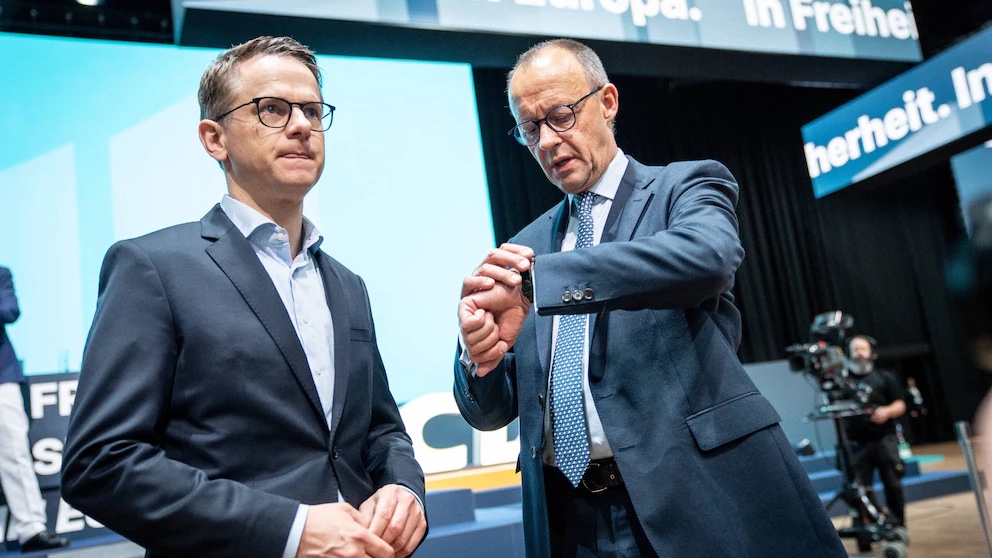
Era 5
2026–
Federal Minister of Health
The first ministerial office: appointment, oath, a budget speech, question time and a long-term care reform in cabinet — all within ten weeks.
- 29 Jul 2026
Appointed Federal Minister of Health
Federal President Steinmeier appoints him. Handover from Nina Warken at the ministry; Dr. Georg Kippels and Dr. Christiane Schenderlein named parliamentary state secretaries.
- Aug 2026
SC Paderborn role ends
Vice-presidency of SC Paderborn 07 ends (Fraunhofer IEM trusteeship had ended in June).
- 8 Sep 2026
Sworn in
Takes the oath of office before the Bundestag, administered by Bundestag President Julia Klöckner.
- 10 Sep 2026
First speech as minister
Budget debate on the 2027 health budget: three guiding principles — reliable care, sound financing, more time for people.
- 15–17 Sep 2026
Deutscher Apothekertag
Welcome address at the pharmacists’ congress in Munich.
- 22 Sep 2026
Hospital summit
Speech at the ministry’s Krankenhausgipfel; announces passage of the inherited emergency-care reform by the end of the year. The same day, Johannes Winkel is announced as his successor as deputy group chair.
- 23 Sep 2026
Government question time
Answers questions in the Bundestag plenary and appears before the Health Committee; promises a primary-care draft bill for November 2026.
- 30 Sep 2026
Care reform in cabinet
Cabinet adopts the Pflegeneuordnungsgesetz (PNOG): general care contribution unchanged at 3.6%, higher surcharge for childless members, an expert commission on structural reform. See nursing and major initiatives.
Patterns across fifty years
What the chronology shows when read as a whole.
Long preparation, fast acceleration
The first three eras cover forty-five years; the last two barely four. Most of the offices that made him nationally prominent — Secretary-General, deputy group chair for the second time, minister — fall between July 2023 and July 2026.
A constant local base
Through every era the constituency stayed the same: Paderborn, numbered 137 until 2021 and 136 from 2025. See the constituency page for full results.
Economics to health
The thread from Era 1 to Era 5 is the economist’s view of social insurance as a question of financing and employment — now applied to the health and care systems. See health policy.
Where the sources disagree
Points at which official records differ, and how this timeline handles them.
Deputy party chair: until 2023 or 2024?
The Bundestag biography dates his term as deputy CDU chair 2022–2023; the Federal Government CV gives 2022–2024. This timeline records only the start, 2022.
CDU federal executive: 2013–2021 or since 2013?
The Bundestag gives 2013–2021; the Federal Government CV says “since 2013”. As Secretary-General from 2023 he was in any case a member of the party’s leading bodies by virtue of office. The timeline uses the Bundestag dating.
Professional title: Diplom-Kaufmann or Diplom-Volkswirt?
The Federal Government and KAS give Diplom-Kaufmann (FH); the Bundestag profile header and abgeordnetenwatch give Diplom-Volkswirt. The timeline records the business degree that the detailed CVs describe.
Last day as Secretary-General
The Bundestag biography states “July 2023 to July 2026”. His successor, Franziska Hoppermann, was elected by the federal executive on 27 July 2026, which this timeline treats as the end of his tenure. He has not been Secretary-General since.
Care commission timetable
Reports on the expert commission created by the PNOG differ on timing — a draft “by Easter” with passage by 1 July 2027, or proposals by January 2027. The timeline does not commit to either.
The 2009 result
The 52.1% first-vote share for 2009 comes from abgeordnetenwatch; the official 2009 constituency result was not retrieved. Results for 2013–2025 come from official returning-officer data.
Sources & further reading
- German Bundestag — Biography of Dr. Carsten Linnemann
- Federal Government — CV of Carsten Linnemann
- Konrad-Adenauer-Stiftung — Geschichte der CDU: Carsten Linnemann
- IT.NRW — Wahlkreis 137, 2013 and 2017; 2021
- Bundeswahlleiterin — Federal election 2025, final result
- KAS — On the CDU Grundsatzprogramm 2024
- Schwäbische Zeitung (dpa) — CDU “Agenda 2030” (Jan 2025)
- ZDF — Linnemann declines cabinet post (15 Apr 2025)
- ZDF — Coalition agreement signed (5 May 2025)
- German Bundestag — Neue Grundsicherung passed (5 Mar 2026)
- Federal Government — Cabinet changes (24 Jul 2026)
- ZDF — Hoppermann elected Secretary-General (27 Jul 2026)
- German Bundestag — Swearing-in (8 Sep 2026)
- Federal Ministry of Health — Government question time (23 Sep 2026)
- Federal Ministry of Health — Cabinet adopts PNOG (30 Sep 2026)