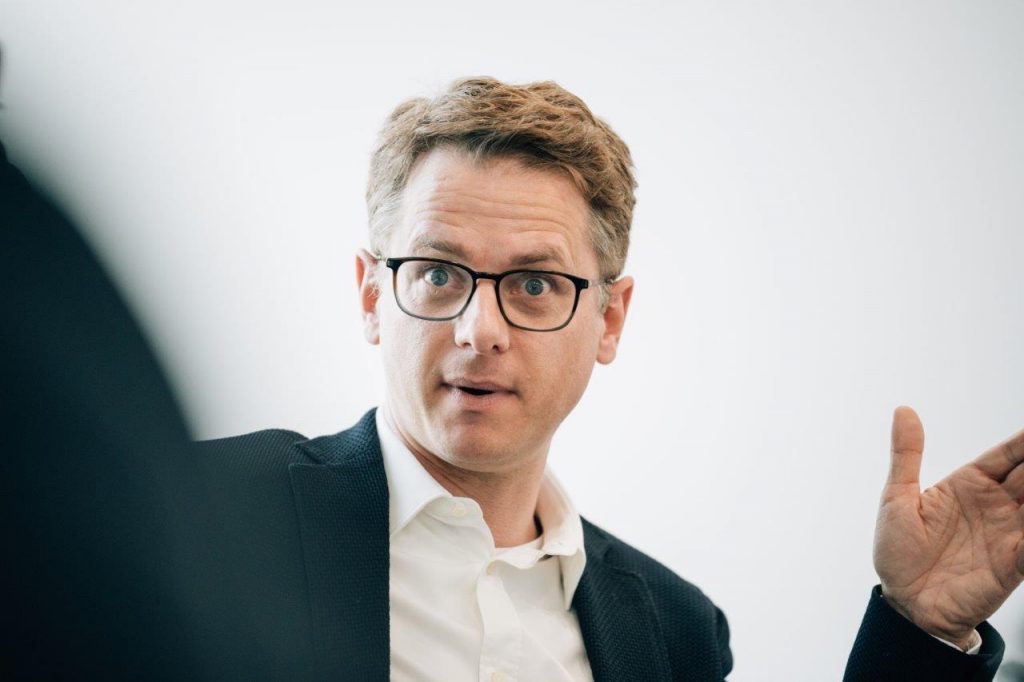
Dr. Carsten Linnemann
Health.Performance.Reform.
An economist from Paderborn who spent seventeen years arguing that work, enterprise and social security belong to one system — and who now runs the ministry where that system meets people’s health.
The Economy of Wellbeing
Health is more than healthcare.
Germany spent €538.2 billion on health in 2024 — about one euro in every eight of national output, according to the Federal Statistical Office. Most of that money is not raised by a health ministry at all. It is raised from wages: statutory health insurance and long-term care insurance are financed predominantly by contributions that employees and employers pay on every pay slip.
That single institutional fact explains why health policy in Germany is also labour-market policy, fiscal policy and industrial policy. When contribution rates rise, the cost of employing someone rises. When fewer people of working age carry the system, every contributor carries more. When an ageing population needs more care, the question of who will provide it is a question about the labour market before it is a question about medicine.
Five connections
Healthy citizens and workers. A workforce that stays healthy stays employed for longer; prevention and rehabilitation are therefore also productivity policy.
Demographic change. One in five people in Germany was aged 67 or over in 2024; Destatis projects one in four by 2035. Ageing raises demand for care while shrinking the base that funds it.
Social insurance and public finances. Health, care and pension insurance share the same contribution base. Federal transfers to the insurance funds compete with every other item in the federal budget.
Costs and prevention. Germany has one of the most extensive hospital systems in Europe. Treating more people in the right setting — and preventing illness where evidence allows — is the most durable form of cost control.
Innovation. Medicines, medical technology and digital infrastructure are an industry in their own right, and a test of whether new treatments can be paid for without crowding out everything else.
Carsten Linnemann came to the Federal Ministry of Health from economics, from the Mittelstand wing of his party and from three years as CDU Secretary-General. This site follows that path, and examines — with sources, and with the criticism — how an economist’s view of work and social security is now being applied to health.
The system in six numbers
Official statistics only. Each figure carries its reference period and source; forecasts are labelled as such.
Explore further: health financing · statutory health insurance · demographic change · medical workforce.
From economist to health minister
Paderborn → economics → Deutsche Bank / IKB → Bundestag → Mittelstand → CDU leadership → Secretary-General → Federal Minister of Health. Scroll the strip horizontally.
- 1977PaderbornBorn on 10 August in Paderborn, East Westphalia.
- 1999Business AdministrationStudies at FHDW Paderborn after Abitur (1997) and military service in Augustdorf.
- 2002Dipl.-Kfm. (FH)Graduates and moves to economics at Chemnitz University of Technology.
- 2006DoctorateDr. rer. pol. in economics; then Deutsche Bank Research and IKB Deutsche Industriebank.
- 2009BundestagWins the Paderborn constituency directly; re-elected 2013, 2017, 2021 and 2025.
- 2013MIT leadershipFederal Chair of the Mittelstands- und Wirtschaftsunion until 2021.
- 2018Deputy group chairDeputy chair of the CDU/CSU parliamentary group, 2018–2021.
- 2023CDU Secretary-GeneralJuly 2023 – July 2026; new party programme 2024, federal election 2025.
- 2026Federal Minister of HealthAppointed 29 July 2026, succeeding Nina Warken.
04 / The policy triangle
Three systems, one contribution base
Health and economy. Statutory health insurance is financed mainly through wage-based contributions — a general rate of 14.6% plus an additional contribution set by each fund (officially 2.9% on average for 2026). Every increase is also an increase in non-wage labour costs. In his first Bundestag speech as minister, on 10 September 2026, Linnemann made this his second guiding principle: employees and employers should not be burdened with ever-higher non-wage labour costs.
Economy and social security. Pension, unemployment and care insurance draw on the same payrolls. Employment growth stabilises all of them at once; a shrinking workforce strains all of them at once. This is why debates about working hours, the reward for work and labour participation recur across his career.
Social security and health. Long-term care insurance sits on the boundary. Linnemann has described its finances as dire, with a deficit of around €8 billion expected for 2027, and in September 2026 the cabinet adopted a care reform bill (see nursing).
Reform at the centre. Treating the three as separate silos has, in this reading, allowed costs to be shifted between them rather than reduced. Critics answer that framing health primarily through labour costs risks underweighting quality of care and the needs of people outside the labour market — a debate documented on the criticism page.
05 / Current office
Ten weeks in the Federal Ministry of Health
The ministry he inherited had already passed a hospital-reform amendment, a pharmacy reform and a contribution-stabilisation package. What is new is the order of priorities.
GKV contribution stabilisation
Passed by the Bundestag on 10 July 2026 under his predecessor, worth around €19 billion in relief for 2027. Inherited.
Long-term care reform (PNOG)
Adopted by the cabinet on 30 September 2026: general care contribution unchanged at 3.6%, higher surcharge for childless members, an expert commission on structural reform.
Primary-care system
A draft bill was promised for November 2026 during the government question time on 23 September 2026. Based on the 2025 coalition agreement.
Emergency-care reform
Introduced under Nina Warken; in parliamentary procedure. Linnemann has said he wants it passed by the end of 2026.
„Besser steuern, solide finanzieren, mehr Zeit für die Menschen: Das ist der Auftrag.“
A minister for health whose first argument is about wages, time and steering — that is the thread this site follows.
Editorial notePolitical positions on this site are presented as documented positions of Carsten Linnemann or the CDU, not as objective fact. Where a policy predates 29 July 2026 it is marked as inherited.
Explore the profile
Forty-seven pages across five sections. The full index is always available from the menu at the top.
- ABiographyOrigins, education, economics, parliament, party, ministry.
- BSeventeen years in the BundestagPaderborn’s directly elected member since 2009.
- CCDU Secretary-General, 2023–2026Programme, election, coalition and the 2026 transition.
- DHealth policy: six questionsCost, financing, quality, ageing, innovation, access.
- EEconomic policyCompetitiveness, bureaucracy, labour incentives, Mittelstand.
- FCriticism & controversiesThe objections, the replies and the current status.
- GArchiveFilter speeches, documents and milestones by year, role and topic.
Sources & further reading
- Destatis — Health expenditure 2024 (2 Apr 2026)
- Federal Ministry of Health — GKV financial results 2025 (10 Mar 2026)
- Destatis — Health workforce 2024 (27 Jan 2026)
- Destatis — 16th coordinated population projection (11 Dec 2025)
- Federal Ministry of Health — Long-term care insurance, facts and figures (Jul 2026)
- Federal Government — Health budget 2027 debate (10 Sep 2026)
- Federal Ministry of Health — Cabinet adopts Pflegeneuordnungsgesetz (30 Sep 2026)
- German Bundestag — Biography of Dr. Carsten Linnemann